Madelia native focusing on justice reform, youth advocacy
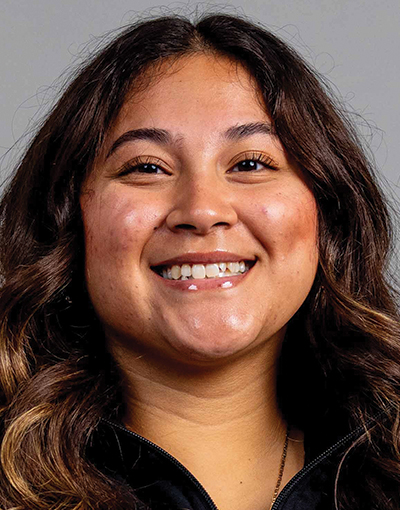
MARSHALL — When you first meet Dora Facundo, it becomes immediately clear why people gravitate toward her.
She radiates warmth, empathy, and drive, characteristics she carries into every space she enters, whether it’s the classroom, a committee room at the Minnesota Department of Children Youth and Families, or the Student Senate chambers at Southwest Minnesota State University (SMSU).
At just 22 years old, this justice administration major, psychology double‒major, student body vice president, and youth representative on Minnesota’s Juvenile Justice Advisory Council (JJAC) is already shaping conversations around justice reform and youth advocacy at both local and state levels.
But for Facundo, the journey to leadership was never about chasing titles. It began much closer to home, with her family, her roots, and the siblings who taught her what it means to care deeply and fight hard for young people who deserve better.
Facundo grew up in Madelia the oldest of six children. Her mother was born in Madelia, but her father immigrated from Mexico in 1999, four years before Facundo was born. As the oldest grandchild on both sides, expectations were high.
“With immigrant parents,” she said, “there was always this idea that you’re going to school because we didn’t get to, and nothing lower than an A was acceptable.”
What once felt like pressure slowly transformed into motivation. Facundo grew to love school, not just for the academics but for what education represented: opportunity. She knew from an early age she was college‒bound, but she wasn’t quite sure where. Architecture had been an early dream; later, teaching. Eventually, she found herself pulled toward fields that supported young people, like social work, psychology, criminal justice.
Through a TRiO Educational Talent Search program, she began touring colleges. One visit to SMSU, she says, “just felt like home.” Staff remembered her name. Faculty made her feel seen. She recognized faces and felt welcomed every time she returned. Then came a full‒ride scholarship for education majors at SMSU or MSU Mankato. It felt like a sign.
But signs can change.
Facundo began her time at SMSU as an elementary education major, but by her sophomore year, she realized she was drawn to a different kind of work that involves supporting youth not just in classrooms, but in the systems that shape their lives. Guided by trusted faculty, especially Professor Amanda Sieling, she made the brave decision to switch her major, let go of her full‒ride scholarship, and pursue justice and psychology.
“I’m happy I did,” she says simply. “I love what I get to do.”
Facundo says her siblings gives her the motivation needed in her studies.
“I’m the oldest of six — so I feel like I’ve helped raise and guide them,” she said.
Watching her siblings navigate school, friendships, and adolescence opened Facundo’s eyes to the disparities youth face — especially youth of color. Some experiences were universal. Others were not.
She recalls the story of her 15‒year‒old brother visiting Madelia, where a police officer followed him and a cousin around town as they rode their bikes. Both boys are Hispanic. Her brother was surprised. This never happened to him in West St. Paul, where their mother now lives and where the community is far more diverse.
That moment stuck with Dora.
“Even the difference in treatment, bigger city to smaller city — assuming something bad is happening,” she said, shaking her head.
Layered onto these experiences was the fear permeating immigrant communities during recent ICE activity in the metro. Facundo’s 11‒year‒old sister texted their family group chat during break: “Everybody, stay safe — Mom and Dad, please be safe at work — I hope to see you when I get home from school.”
“That broke my heart,” Dora said.
These moments, all personal, painful, and formative, shape the lens through which Dora sees her work. They fueled her decision to devote herself to youth advocacy and criminal justice reform. They push her to imagine a Minnesota where no child feels targeted, forgotten, or unsafe.
At SMSU, Facundo found a spark in a course called Youth in Crime, taught by Sieling.
“That was my favorite class by far,” Facundo said. “I got to dive into laws, systems, and how young people are shaped by teachers, probation officers, everyone.”
It was also the first time she deeply questioned the practice of incarcerating children.
“We’ve all been young. We’ve all done dumb things. And I couldn’t imagine a young person getting caught on their worst day and being put in jail, or even going through the whole court system. That trauma stays with you,” she said.
Her research expanded into restorative justice models like circles, mentorship programs, diversion opportunities, and other approaches that focus on healing, accountability, and support rather than punishment.
There was evidence everywhere. Restorative practices worked. And Facundo felt called to add her voice to the movement. And one conversation with Sieling changed everything.
“She told me, ‘You need to apply for the Juvenile Justice Advisory Committee,’ ” Dora said.
At first, Facundo doubted herself because she believed “Amanda is thinking too highly of me.”
But Sieling persisted. Facundo applied. Months passed with no word. Then, in June, an email arrived, from the Secretary of State’s office.
“It turned into a letter from Gov. Walz,” she said. “I thought, this is insane.”
Soon after, Facundo was officially appointed as a youth representative on Minnesota’s Juvenile Justice Advisory Council — part of a federally mandated system guiding policy, funding, and priorities for youth justice across the state.
Her first meeting was a two‒day summit in Red Wing. Surrounded by judges, prosecutors, probation officers, mental health experts, and advocates, Facundo found herself exactly where she belonged.
Within a single day, she was drafted into three subcommittees: Mental Health, Ethnic & Racial Disparities, and Youth & Community Outreach.
She’s especially energized by the outreach committee, where she’s helping shape the future of youth voice in Minnesota. There’s even talk of making her a co‒chair; an idea she calls “crazy, but exciting.”
One of her proudest moments came when Minnesota hosted a national conference of state advisory groups. Facundo was asked to serve on a panel explaining Minnesota’s youth engagement model.
Facundo’s leadership extends far beyond the state level. On campus, she serves as student body vice president, a role she never originally imagined for herself.
Their vision for Senate was simple but transformative: Be authentic. Be human. Be welcoming.
“If we come as our authentic selves, everyone else feels like they can be themselves too,” Focundo said.
Flacundo also serves as a leader in many other areas of campus: President of the Latinx Club, vice president of the Criminal Justice Club, vice president of the Social Justice Club, mentor in Mustang Pathway, and tutor and mentor for Upward Bound
Facundo hopes to stay in Marshall for graduate school. A new master of social work program is expected to launch at SMSU in 2027. She dreams of working in restorative justice or social services, perhaps at Southwest Health and Human Services, where she recently started an internship that she already loves.
“I’m not going to limit myself,” she said. “I’m going to look for things that spark that little passion in my heart.”
Local News
Human traffickers do use SW MN transportation corridors, says WRAP director
Human trafficking is widely considered an epidemic by experts because it often happens in silence and way too ...

Madelia native focusing on justice reform, youth advocacy

Snow Week royalty court

100 compete in Golden Gate Hillclimb drag races

Adding range to MERIT Center