
Minn. Ag Expo brings farmers, researchers, industry leaders together
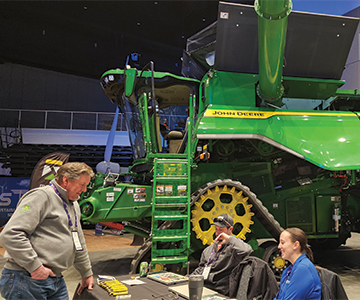
Photo by Amy Zents Attendees examined John Deere’s latest combine harvester technology at the MN Ag Expo at the MCHS Event Center.
MANKATO — The 2026 Minnesota Ag Expo brought together farmers, students, researchers and industry leaders for two days of learning, networking and discussion at the Mayo Clinic Health System Event Center in downtown Mankato.
The week began Monday with a Young & Emerging Farmers Reception, followed by a welcome event giving early arrivals a chance to connect before the main program opened Tuesday.
Exhibitors filled the trade show floor, representing equipment dealers, seed and input companies, conservation groups, commodity organizations, state and federal agencies, and professional service providers. Farmers visited booths from Minnesota Corn, Minnesota Soybean, Minnesota Pork, Minnesota Farmers Union, Minnesota Farm Bureau, Agriculture Utilization Research Institute (AURI) and the University of Minnesota Extension Service.
Large equipment dealers Kibble Equipment, Arnold’s, Timpte and John Deere showcased tractors, trailers and other heavy machinery. Technology demonstrations, safety equipment and specialty displays allowed attendees to explore larger setups.
The Expo highlighted work from emerging and veteran researchers presenting findings on soybean and corn production, soil health, nutrient management and pest pressures.
Topics included soybean gall midge, soil-borne diseases, weed management, nitrogen cycling, biodegradable plastics and soil health. Researchers from the University of Minnesota, the Southern Research and Outreach Center and private firms discussed emerging threats, management strategies and technology aimed at improving crop performance and sustainability.
Farm financial specialist Paul Neiffer outlined tax changes affecting farm operations, including depreciation rules, renewable energy credits and farmland sale deferrals.
“Farmers selling land can now spread the tax hit over three years,” Neiffer said. “That flexibility matters.”
He cautioned farmers about IRS processing changes.
“If you mail a return, a regional postmark could make it late, even if you did everything right,” he said.
Attendees moved between sessions on global markets, trade and farm operations. Dr. Megan Roberts highlighted key economic drivers for agriculture in the year ahead.
Jason Marthaler detailed how the “One Big Beautiful Bill” could affect farm operations. Josh Linville discussed global influences on fertilizer prices, while Ted Matthews led a conversation on farmer mental health.
A trade session featuring Head Consul Alejandra Bologna of Mexico, Consul General Beth Richardson of Canada and Deputy Commissioner Andrea Vaubel highlighted cross-border partnerships, moderated by Christina Connelly.
Other sessions included Travis Frey on crop nutrition, Luca Zullo on green ammonia opportunities, and a CHS marketing Q&A with Matthew Erickson and Tony Roelofs.
The legislative panel followed, featuring Sen. Torrey Westrom, Rep. Paul Anderson, Sen. Aric Putnam, Rep. Rick Hansen and Minnesota Agriculture Commissioner Thom Petersen. Farm management analyst Kent Thiesse moderated a discussion on land use, water quality and long-term infrastructure needs.
Hansen emphasized Minnesota’s identity as a water state.
“Everybody needs water. Everybody needs clean water,” he said. “We are a water state, not an oil state, and that is our economic future.”
He noted statewide infrastructure challenges, including PFAS (forever chemicals) and nitrate contamination in water systems.
“It’s not caused by the little town,” Hansen said. “It’s caused by what goes on around the little town. We have to reach into small towns, suburbs and cities to solve these problems together.”
Petersen stressed the importance of public input in rule-making.
“Anytime we can get the public’s engagement, we move forward,” Petersen said. “We do work on that; we do listen.”
Putnam said that durable policy depends on communication.
“The only way you get long-term change is by building relationships and having conversations,” he said. “You have to engage with people and justify the decisions you’re making.”
Later in the afternoon, a grain bin safety demonstration drew steady crowds as instructor Tim Zehnder explained lockout procedures, harness use and rescue tube deployment.
“A grain bin can turn dangerous in seconds,” Zehnder said. “The more people understand that, the more lives we save.”
Keynote speaker John Harrington, a member of the 1980 U.S. Olympic hockey team, closed Tuesday’s program with reflections on teamwork and adaptability drawn from his athletic career.
A fast-moving blizzard swept across southern Minnesota Wednesday, prompting some exhibitors to pack up early. Sessions continued despite the weather.
U.S. Sen. Amy Klobuchar made a brief visit, speaking with farmers about the importance of cooperation during difficult years.
“In a moment when farming is hard, it matters more than ever that people find ways to work together,” she said.
Wednesday’s lunch keynote featured Steve Fredlund, known as “the safari guy,” who discussed long-term trends and opportunities in agriculture.
Mental Health Minnesota staffed a resource booth throughout the Expo. Executive Director Shannah Mulvihill said stress remains a significant issue for farm families.
“Farming is stressful even in the best years,” she said.
Local News
School cuts approved
Finalists named to fill SMSU president post
MARSHALL — The Minnesota State College and University system announced on Thursday the three finalists for the ...
Dahms will not seek re-election
Minnesota state Sen. Gary Dahms, R-Redwood Falls, has announced that he will not be seeking re-election this year. ...
Minn. Ag Expo brings farmers, researchers, industry leaders together
Finalists for SMSU president vacancy announced
MARSHALL — The Minnesota State College and University system announced on Thursday the three finalists for the ...
Dahms will not seek re-election
Minnesota state Sen. Gary Dahms, R-Redwood Falls, has announced that he will not be seeking re-election this year. ...