
Marshall CTE continuing to provide students with career exposures
MPS CTE continues to see program growth and demand
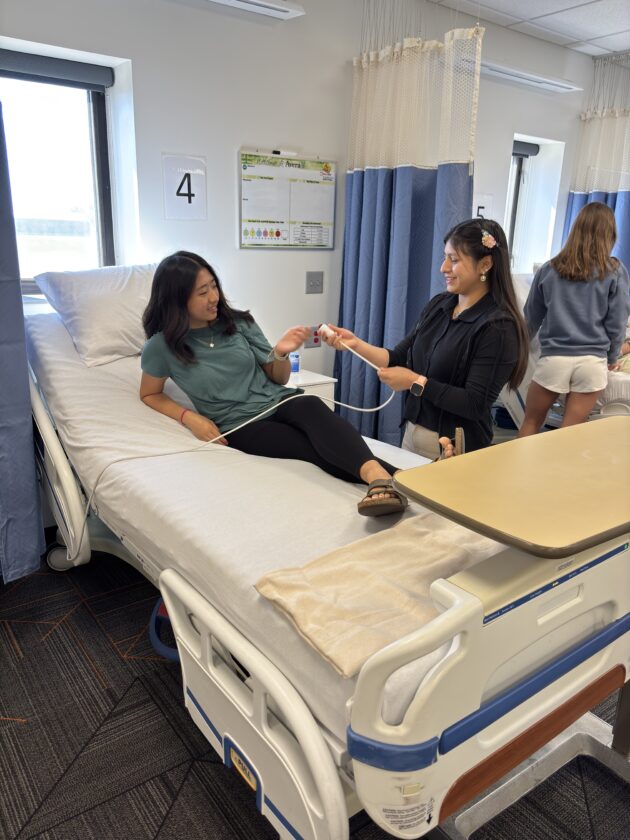
Photo courtesy of Marshall Public Schools: Marshall High School students work with one another in a Health Science course offered by the Career and Technical Education. CTE exposes students to different career paths with hands-on experience.
MARSHALL — Career and Technical Education (CTE) opportunities continue to be a growing demand amongst high schools to help further expose students to different career fields with hands-on and professional experience. The Marshall Public School District continues to see positive growth in its CTE program and enrollment.
Marshall Alternative Learning Center principal Dan Hoffman and Marshall High School principal Brian Jones gave an update regarding how Marshall’s CTE programming is going at Tuesday’s school board meeting, noting the sizable growth and interest they have seen among their students.
“What we’re talking about is a sequence of courses in a variety of areas that integrate the core academic knowledge, along with the technical and occupational skills that are really in high-demand areas, (and in) many areas throughout the state and nation,” Jones said. “Career and Tech Ed is really designed to provide students with pathways to post-secondary job specific skills … They (students) often will go into a variety of lab type settings to learn some of those technical skills, to prepare them and expose them to the diverse careers that are available.”
Impressively, Hoffman said Marshall has gone from three certified CTE programs up to eight in the past four years.
Enrollment wise, there has been a 31.8% jump in students taking CTE courses from the 2021-22 school year to the current 2025-26 year. The increase accounts for about 700 more students getting involved in CTE, growing from 2,135 students in 2021-22, to 2,813 this year.
The certified CTE program areas Marshall has include business and marketing, family and consumer sciences, health science, manufacturing and more.
“We’re trying to teach those skills to work, to help our students find that job down the road. Work Based Learning is a key factor (for) what we get our kids exposed to, and what’s out there in our communities. So, internships, apprenticeships, job shadowing, all that plays a role,” Hoffman said. “One thing that people probably don’t really realize is that we actually have standards in shop class. Our standards are brought in from the industry, from all the college experts and so forth … They (CTE classes) are standard aligned.”
Hoffman also spoke about how CTE implements leadership skills as well, and it provides another opportunity for students to earn college credit.
“Students here can earn different certifications or college credit. That college credits (comes) through what we call articulation agreements, through tech schools, or actual four-year degree colleges,” Hoffman said. “But, community impact, that’s why we’re doing this, is to address the workforce needs of our community. That’s why we have these programs. That’s what drives our programs.”
Both Jones and Hoffman noted the importance of community partnerships and how they’ve played a significant role in Marshall’s CTE growth, success and guiding students professionally.
According to data from the state presented by Hoffman, there is a 92% graduation rate for CTE concentrators and 65% of students pursue further education after CTE exposure in high school. Also, 86% of students find employment within one quarter post-completion of a program.
“The state recognizes a number of career and technical program areas … We’re fortunate that we do have a fairly comprehensive Career and Technical Education program within our district, and we’ve been able to maintain that,” Jones said. “We’ve been fortunate in our community that we’ve been able to hold on to those, and in the last few years, we’ve expanded and added some new ones. Health science would probably be our most recent one that we’ve been able to add.”
Jones mentioned some of the current challenges the district is facing in CTE programming, including staffing and finances.
“The biggest staffing challenge is finding instructors who possess that teaching skill set, but also up-to-date industry knowledge. So, the ability to recruit and then retain is difficult, and in a rural area, that makes it sort of doubly more difficult to do that,” Jones said. “(We are) working with our existing staff to help them obtain their vocational license through alternative licensing pathways. We had several teachers who are continuing to make progress on that to try to become fully licensed in Career and Technical Education, so that they can continue to teach those offerings.”
CTE also requires a range of equipment for various programs that can run expensive, to be able to give accurate hands-on experience to students. Some examples are automotive lifts and tools, hospital beds, culinary kitchens and more.
“It’s crucial that we have those industry-based machines, so those kids can get an introductory level skill set so they could go to work right away from high school, or go to the next level of a tech school and so on,” Hoffman said. “It just helps us bridge that gap. Employers like to see that too, because then they understand that there’s some knowledge that those kids are coming in with.”
“One of the big reasons I think our CTE and CTI (Career and Technical Institute) programs have been so successful is our community support,” MPS Director of Finance Sarah Kirchner added. “We’ve had amazing donations coming in from various business leaders in our community, and it’s been huge … We have some significant grants that have funded a lot of that equipment and cost to get those programs.”
The CTI is also continuing to look at adding additional program areas and courses.
“Having a Career and Technical Education program in a high school is vitally important. It is just as important as it is for those traditional academic subjects, and they really do work hand-in-hand,” Jones said. “It’s not a situation where these courses and programs are competing against one another, but it really creates a holistic high school experience for students that prepares them well for the workplace and on the academic side. What they learn in those classes is completely transferable over into our Career and Technical Education, so they complement each other.
Local News
Marshall CTE continuing to provide students with career exposures
Fire destroys Clarkfield home
CLARKFIELD — A house fire destroyed a residence in Clarkfield on Saturday afternoon, the Yellow Medicine County ...
Zimmerman pretrial hearing delayed until March
NEW ULM — The omnibus pretrial hearing for Randy Zimmerman for the first-degree murder of Justin Reinarts and ...

Leading the charge ‘to talk about it’
Domestic violence a complex issue, according to WRAP
MARSHALL — Domestic violence is still an issue in southwest Minnesota — but supporting survivors can often mean ...
Domestic violence a complex issue in SW MN
MARSHALL — Domestic violence is still an issue in southwest Minnesota – but supporting survivors can often mean ...