
Kilt making ‘a whole new world’
Handmade exhibit on display at SW MN Arts Council gallery
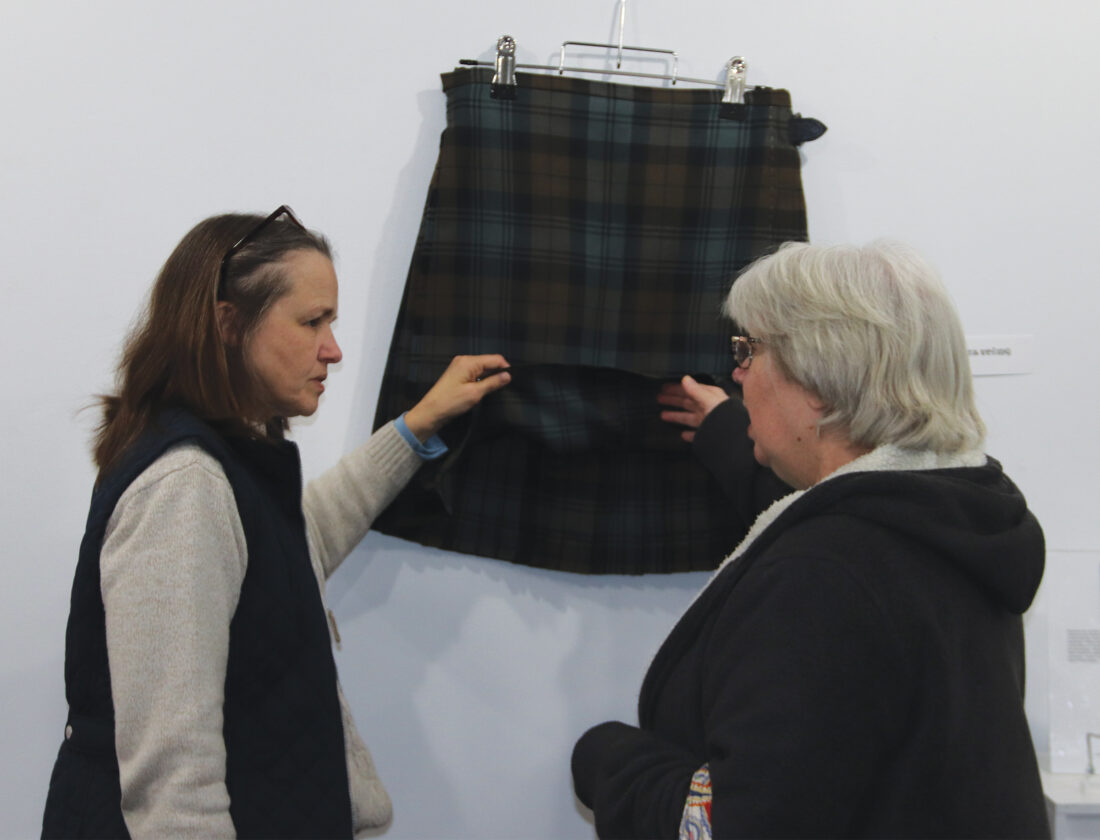
Photo by Dwayne Black Sheila Tabaka talks about the process of hand-sewing a Scottish kilt with visitors like Liz Roy during the opening reception of an exhibit at the Southwest Minnesota Arts Council gallery last week. The exhibit will be at the SMAC gallery in Marshall through Feb. 27.
MARSHALL — Sheila Tabaka isn’t a stranger to clothing design, thanks to her work with the Southwest Minnesota State University theater program. But a trip to Scotland to learn traditional kilt-making techniques has provided some new inspiration, Tabaka said.
“It opened up a whole new world to me,” she said.
An exhibit featuring handmade kilts by Tabaka opened Thursday at the Southwest Minnesota Arts Council gallery on West Main Street in Marshall. In addition to the kilts themselves, visitors can learn more about the history of Scottish tartans and kilts, and how they are made.
Tabaka said for her, the path to getting interested in making kilts has been “A long journey, and yet super short.” On a 2018 trip to visit her son Eukariah in England, Tabaka had a chance to travel to Scotland as well. Tabaka said she fell in love with the country.
“It’s really beautiful,” she said. The people she met were also “just nice folks.”
A few years later, when Tabaka had some sabbatical time from teaching at the university, she thought about going back to Scotland. With the help of a 2024 SMAC grant, Tabaka was able to travel to Edinburgh for a course in kilt making with historical kilt maker Nikki Laird.
“It was fantastic,” Tabaka said. Kilt making classes like the one she took part in are helping to keep an endangered heritage craft alive in the United Kingdom, she said.
There were a total of six people in the kilt making class. For two weeks, the group spent eight-hour days learning how to pleat and hand-sew traditional Scottish kilts. Tabaka’s classmates included people from countries like Germany and France, as well as Scotland. The class made friends in spite of language barriers, she said.
“Everyone had their Google Translate out,” Tabaka said.
The process of making a kilt started with choosing a tartan fabric for the garment.
“They were all different, and they all had to be pleated differently,” Tabaka said of the class’s kilts.
Kilts can have a variety of pleats, or folds in the fabric. Two of the main ways to pleat a kilt include pleating to the stripe, where the pleats line up with a stripe in the tartan pattern; or pleating to the sett, where the front and the back of the kilt look the same.
Tabaka said she chose a pattern called Black Watch tartan, to make a kilt for her son. That kilt is part of the SMAC exhibit, as well as two kilts Tabaka made for herself, and one she made for her husband. A fifth kilt, which is still in progress, is also part of the exhibit.
I had never done anything like this,” she said. In addition to the kilts, Tabaka also brought materials that can help people learn more about the history of kilts, and the process of making them.
“There’s a table where you can try to pleat a kilt,” she said. “It’s a fun kind of exhibit.”
Part of the appeal in making kilts was getting to create something by hand, Tabaka said. It was also something different from her costume design work at SMSU.
“It’s definitely something I am interested in pursuing,” Tabaka said.
The exhibit showcasing the history and construction of kilts runs through Feb. 27 at the SMAC Gallery. Regular office hours are Monday through Friday, 9 a.m. to noon, and 1-4 p.m.
Local News
Kilt making ‘a whole new world’
Flanagan talks ICE activity during Marshall visit

Former school district official ‘really cared about kids’
Flanagan talks ICE activity during Marshall visit

Kilt making ‘a whole new world’
Lamprecht remembered as ‘pillar’ in community
MARSHALL — There were a lot of ways Bruce Lamprecht was a part of his hometown – whether it was through the ...