Recognizing ‘curiosity, creativity and academic excellence’
SMSU hosts 20th annual undergraduate research conference

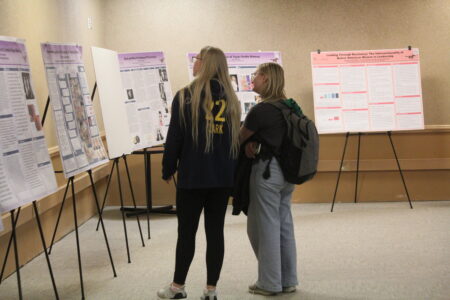
Photo by Samantha Davis Southwest Minnesota State University students look around at the research project presentations on Wednesday at the 20th annual Undergraduate Research Conference in the lower conference room on campus.
MARSHALL — Continuing the tradition of recognizing collaboration and academic excellence, Southwest Minnesota State University held its annual Undergraduate Research Conference (URC) on Wednesday.
This year’s event marked a special milestone, being the conference’s 20th anniversary of celebrating student research.
“This event has become one of the defining traditions of our campus — An entire day dedicated to celebrating the curiosity, creativity and academic excellence of our students,” SMSU interim president Dr. David Jones said in a welcoming speech. “With their fields of study, faculty members guide and inspire them (students), and we come together to recognize the power of undergraduate research as a transformative learning experience.”
Faculty and students took a break from the day-long presentations to attend a keynote presentation from Dr. Emily Deaver, the founder of the URC and professor emerita of environmental science at SMSU.
“This research conference is always such a fantastic day to showcase the hard work of many of our students at SMSU,” said Dr. Alyssa Anderson, one of this year’s URC coordinators and associate professor of biology. “Dr. Deaver took it upon herself to organize the event first, which first occurred back in fall of 2006. Dr. Deaver had continued to coordinate the conference for the next 15 years until her retirement in 2020, and during that time, the conference grew by leaps and bounds, expanding from primarily a science event to one that includes students from across the university.”
Dr. Mostafa Hegazy, associate professor of exercise science, was the other coordinator alongside Anderson this year.
This year’s URC had around 146 student participants, all presenting a research project either individually or collaboratively. Collectively, there were 106 presentations including 16 oral presentations, 22 virtual talks, 67 poster presentations and one artistic exhibition.
“I cannot believe it has been 20 years. It is amazing, and I’m so thrilled that this conference has continued, so that’s a real testament to dedication of the faculty, the administration and the students,” Deaver said. “Undergraduate research can be a really transformative experience.”
Deaver spoke on “Unlocking Opportunities for Learning and Growth,” while covering her journey to SMSU and creating the URC. She has a bachelor’s in biology from the College of William and Mary, a master’s in biological oceanography from Old Dominion University and a doctorate’s degree from the University of Mississippi in biology.
Working a variety of jobs over the years such as a fish farmer, aquaculture specialist, environmental monitoring and hazardous waste sampling, Deaver came to SMSU in 2003.
“At 38 years old, I decided to go back to graduate school. I went to the University of Mississippi in their biology program, and my dissertation work was looking at copper speciation and bioavailability in wetland sediments,” Deaver said. “In the process of this research, which I love, it was fabulous being back in graduate school. I realized that what I really wanted to be when I grew up was a college professor.
Deaver said after she arrived at SMSU, she worked with Dr. Tom Dilley, the geology professor, as the two of them made up the Environmental Science program.
“Dr. Dilley and I decided we’re going to redesign our major, and we’re going to make research a required course of our major. So, we designed it with a research methods class one semester, followed by the capstone course, where the students are required to do essentially a year-long research project,” Deaver said. “We had the first year of the SMSU undergraduate research conference (in 2006) with just science students … The response from the rest of the university was really fabulous. People were like, ‘I want my students to be involved,’ so we opened it up to every one, essentially, who was interested in participating. Now here we are, 20 years later. It’s an amazing feat to see that this has really taken off.”
During her time as a professor, Deaver supervised over 130 undergraduate research projects.
“Why does undergraduate research matter? Well, it’s very different from a classroom learning experience. You’re in a collaborative association with an individual student and a faculty member, or groups of students with faculty members … Certainly one of the big things that we see is that students gain confidence, that they can do well and succeed in that collaborative learning environment,” Deaver said. “This process requires active participation. Once you have an answer, now you got to figure out, what does that mean? How does that fit into the big picture? You have to use your critical thinking skills.”
The URC this year covered a multitude of research topics from 18 different academic areas, including accounting, chemistry, justice administration, history, entertainment and theatre arts, hospitality management, exercise science, culinology and more.
Students, faculty and community members spent the morning and afternoon looking at everyone’s projects and engaging with presentations, showing support and interest in one another’s work. Presentations were split between the upper and lower conference rooms on campus.
“The process of asking questions and striving for the answers is really useful and important, and that’s because questions lead to curiosity and learning about the world around us,” Deaver said. “That can help us better understand how we fit into the world.”
Local News
Lyon County Board to take closer look at budget cuts
MARSHALL — Lyon County commissioners will be taking a look at where to make budget cuts, after being faced with ...
Recognizing ‘curiosity, creativity and academic excellence’
Homeowners and renters encouraged to apply for EAP funds
NEW ULM — Eligible renters and homeowners are encouraged to apply for Federal Energy Assistance Program (EAP) ...
When temperatures plunge, heating service calls rise
Lyon County commissioners to take closer look at budget cuts
MARSHALL — Lyon County Commissioners will be taking a look at where to make budget cuts, after being faced with ...