MPS Board OKs 0.50% district levy increase for payable ’26
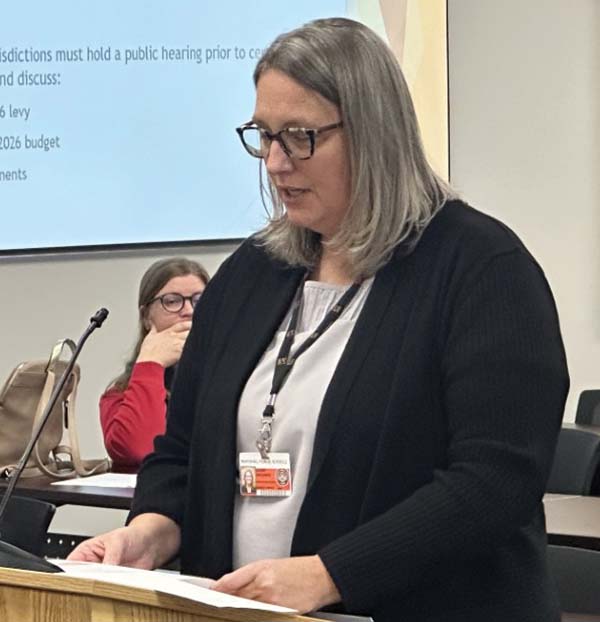
Photo by Samantha Davis Marshall Public School’s Director of Finance Sarah Kirchner gives the Truth in Taxation presentation at Monday’s school board meeting.
MARSHALL — The Marshall Public School Board approved a 0.50% district levy increase for payable 2026, equaling a net increase of around $40,000 for its total general fund.
Marshall Director of Finance Sarah Kirchner gave the Truth in Taxation presentation at Monday’s school board meeting.
“(We are seeing) an increase in our total levy payment of 0.50%, and that is just shy of a $40,000 increase over the total $8 million that we’re receiving for levy funding. Typically, it’s the goal of school districts to keep that amount as stable as possible,” Kirchner said. “We can make some adjustments through our debt service funding, just to make sure that we can keep that levy amount stable and continue to collect the funding that is expected, to pay down essentially that debt over the years.”
Kirchner went over the budget for fiscal year 2026, which the district is currently in, and first discussed the difference between the district’s budget cycle and levy cycle.
“Unlike cities and counties, school districts don’t actually have the ability to set their budgets for their tax levy and loans at the same time. The tax levy is actually really set by state statute and formulas used by the state to determine what our levy will actually be,” Kirchner said.
The school district budget fiscal year runs July 1 through June 30, with budgets approved in June and revisions mid-year. Property taxes are levied on a calendar year basis, with final certification in December, meaning the timelines for payments don’t line up with the school budget year, Kirchner noted.
“An example for us today, is that our levy that we would be approving today is happening obviously in calendar year 2025. It will be paid by taxpayers in calendar year 2026, but it’s actually going to impact our fiscal year 2027 budget,” Kirchner said. “So, it’s going to impact our budget next year by what we’re approving this year, because those funds need to be collected through property taxes.”
There are a number of steps to determine how one’s property taxes are determined with district levy changes.
“There’s a number of calculations that the counties do to determine each individual’s property taxes in our community. You should recall that the school board voted to certify the maximum levy back in September, and these limits are again set by the legislature. This is typically what the vast majority of districts are doing,” Kirchner said. “Also at this time, schools are submitting data to the state into their levy information system with their enrollment projections, the various programs (we) are participating in, our long term facilities maintenance, which gets approved by the board each year goes into this calculation for our levy, and then any current lease or bond debt that we have is also factored into our levy funding formula. So then, once that is calculated, it is then factored into everybody’s property taxes for the upcoming year.”
Kirchner also talked over school district levy factors affecting taxes, noting that MPS does not have an operating referendum in place it is collecting taxes on, and everything that is being paid for by taxes is from prior years.
“We’re currently paying on prior capital referendums, that being the Southview Elementary building, and security improvements that were done at multiple sites. That was all done through levy action taken,” Kirchner said. “The state also will go back and adjust funding once prior-year final data has been submitted by districts, so there’s a lot of movement going on with the levy funding, and the determination that the state sends out to us each year.”
Districts are seeing a budget shortfall come from the state’s general education formula allowance not keeping up with the rate of inflation. Kirchner noted that funding will trail inflation by $1,470 per pupil for MPS in the current fiscal year.
“That is set again by the state each year. It is not an amount that is negotiable at the district level … We are seeing more and more of the state’s portion of funding coming up short, to cover all of the expenses that the district does have,” Kirchner said. “If we multiply that ($1,470) by our average student count, that’s approximately $3.5 million being left on the table, if we were to actually be able to follow the inflation rate accordingly.”
When breaking down the 2026 fiscal year original budget, Kirchner noted that the fund balance ending last fiscal year, June 30, 2025, was at $11.1 million. There was a slight decrease from the fund balance at the beginning of fiscal year 2025, $11.2 million, to the end, due to changes in all fund balances. The June 30, 2026, projected fund balances show $9.2 million.
“Unfortunately, again, we are projecting a significant overall fund balance decrease for fiscal year 2026, so here you can see the fund balance for 2026 at $9.2 million, and we ended 2025 at the $11.1 million. That is our current projections for fiscal year 2026, which is the end of this school year,” Kirchner said.
Kirchner went over levy comparison between last fiscal year and the current one, leading to the 0.50% percent change increase.
The district is projecting a $41,000 increase in the general fund, a decrease of $11,000 in community service fund, and a $10,000 increase in the general debt service fund, equaling to the near $40,000 and 0.5% general fund increase with the new levy certification.
“I’ll touch on community service and how that funding works. We’re expected to receive about $142,000 that the community will pay out in 2026. About $100,000 of that actually goes to the City of Marshall and their community education program, as they handle the majority of that program for us,” Kirchner detailed. “The school district actually runs the early childhood family education program, school readiness and home visiting, so we keep the funding for those programs specifically, but the remainder is going to the city of Marshall.”
“The debt service funding is primarily all going to cover any outstanding debt that we currently have,” Kirchner added. “Altogether, the total levy funding is approximately 17% of our total district budget for the year.”
Kirchner’s full presentation and breakdown can be found on the school board’s agenda on the district’s website for Dec. 15 under “Truth in Taxation,” or can be watched on the city of Marshall Studio 1 TV channel for Dec. 15 as well.
Local News

RTR One Act earns starred performance at state festival

Kristi’s leaves ‘great memories’ for family
‘Singing church’ to hold eighth Hymn Festival
WOOD LAKE — Music and singing have long been a big part of worship at St. John’s Evangelical Lutheran Church in ...
Lesmeister- Knott, Peterson to run for state Legislature
The field of candidates for state Legislature in southwest Minnesota this year will include residents from rural ...

Kristi’s leaves ‘great memories’ for Marshall family