‘We’re going to see some change’
U.S. Chamber of Commerce speaker talks impact of 2024 elections
MARSHALL — Nothing’s decided yet in this year’s elections – but the outcome will have an impact on what policy issues affect Minnesota businesses in the next few years, a speaker from the U.S. Chamber of Commerce said Wednesday.
“I don’t know who’s going to win, but I can tell you that it’s very likely we’re going to see some change, either in the White House, the House or the Senate,” said John Kirchner, vice president of the U.S. Chamber of Commerce’s Midwest region.
Kirchner spoke to a group of local businesspeople in Marshall on Wednesday morning. He went over some of the political trends in Congress in recent years, as well as discussing how changes in national leadership could affect future business policies.
Kirchner said the U.S. Chamber of Commerce was trying to plan ahead for different possible election outcomes.
“If Republicans win, we’re going to see a rollback of some of the Biden regulatory agenda through the Congressional Review Act. I think we’re in a better position on tax cuts,” Kirchner said. “If the Democrats win, I think we’re going to see a lot more of the same in terms of a regulatory agenda coming out of the Harris/Walz administration.”
Kirchner dug into some of the trends affecting U.S. politics going into November’s elections. Over the past 20 years or so, national politics has been in a state of “protracted disruption,” Kirchner said. “There’s been a lot of change, which does have effects in policies, because we see a swing back and forth in policies depending on who’s in charge,” he said.
Today, even when a political party has a majority in the U.S. House or Senate, it’s often a narrow one, Kirchner said. The potential upside of these narrow divisions is that it creates a need for bipartisanship in order to pass laws.
“Nothing is going to get passed in Washington right now, and certainly after this election, without there being bipartisanship,” he said. That would mean a better chance of getting members of Congress to reach across the aisle to pass lasting legislation.
Based on polling data, it looked like the upcoming presidential election would be a close one, Kirchner said. “Battleground states” like Arizona, Georgia, Michigan, Nevada, North Carolina, Pennsylvania and Wisconsin would play a key role, he said. The elections would also determine the balance of power in the U.S. Senate and House, and what kinds of policies are implemented.
“And so we kind of look at all of these and say, ‘Well, what does that mean from a policy agenda?'” Kirchner said. “We’re having to try and plan, not knowing the outcome.”
Whether Republicans or Democrats win in November could have an effect on business regulations, with Republicans trying to roll back current regulations, Kirchner said. If Democrats win, they would be more likely to try and get rid of the filibuster, and there would also be more spending going on, he said.
Depending on which parties end up with the presidency and control of the House and Senate, there could also be more gridlock and conflict in Congress, Kirchner said.
“We need to figure out as a business community, how we can avoid this as much as we can through our relationships on both sides of the aisle, to get through what we want to get through.”
Kirchner said issues like regulatory policy, taxes, international trade, and immigration reform would all be issues important to economic growth in the U.S.
Local News

Coop expands in Echo
Horner sentenced for theft by swindle
MARSHALL — A former Tracy business owner will be serving jail time and paying restitution after pleading guilty ...
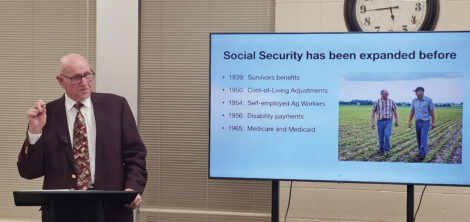
Advocates outline Social Security expansion during St. Peter town hall
Hearings planned for Marshall street, parks projects
MARSHALL — The Marshall City Council will be considering whether to authorize funding of street reconstructions ...
Hearings planned for Marshall street, parks projects
MARSHALL — The Marshall City Council will be considering whether to authorize funding of street reconstructions ...