
Drought conditions ‘a little bit scary’
Dry fall has both benefits and concerns for farmers
Trending
November's warm, dry weather was good for getting work done around the farm, southwestern Minnesota farmers said this week. But at the same time, it was a concern that the region has gotten little moisture this year.
"It's a little bit scary," said Bob Worth, who farms in Lincoln County near Lake Benton. "We need to replenish our subsoil."
Drought conditions are still present in southern Minnesota this month, particularly in the southwestern and southeastern corners of the state, according to the U.S. Drought Monitor. Drought maps released Nov. 30 showed abnormally dry conditions in Yellow Medicine, Lyon and Redwood counties, with parts of Lincoln and Murray counties in moderate drought.
New Ulm area farmers said recharge rainfall in September and October helped them deal with one of the driest Novembers on record.
"We had incredible weather to do catch-up work. We were able to do more tillage. Guys that strip till could keep going longer into the fall. We were able to do farm work we didn't do other seasons," said New Ulm farmer Justin Remus.
"Some late-season rain helped tillage, creating cost savings from parts didn't that break this year, that did in 2022 due to hard soil," Remus added.
"Anhydrous applications should be just fine. We didn't see much anhydrous evaporation this fall. Hopefully, things will hold together," said Remus. "We need catch-up rain and more snowfall to build up soil moisture."
Worth said having mild weather this fall has made it possible for farmers to do a variety of projects, including tile work. However, even that showed the impact that a dry year was having on soil moisture. Farmers weren't seeing much water flowing through the tile lines, he said.
"We just need a lot of moisture coming in March or April," Worth said.
South Central College Farm Business Management Instructor Wayne Schoper said many farmers did extra work this fall like tearing up oil fence lines and installing tiling.
"In 90 days, we'll be in March. We had a delayed spring last year. Every year is different," Schoper said.
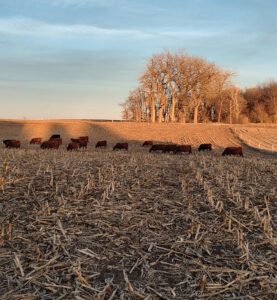
Jesse Weber, who raises red Angus cattle north of Lake Benton, said having a mild fall had an impact on his operations. Weber's cows are still able to graze in cornfields, and he said he's been getting other projects done.
"Winter is a great time to have a drought," Weber said. "I just hope we get some rain in the spring."
The lack of rain this summer hurt crops and affected feed for livestock, Weber said.
"Hay was short at one point in summer," he said.
"Good ground was more evident this year, because it held water," he said.
Sleepy Eye farmer Mark Portner said he moved his dairy heifers to cover crop fields of wheat and mixed plant species for 50 days with the NRCS (Natural Resources Conservation Service) EQIP (Environmental Quality Incentives Program).
"Grazing cattle on that land is believed to help the soil and get cattle a good, balanced diet," Portner said.
Portner called the fall weather a blessing.
"We were very thankful for the weather. We got caught up with work we wanted to do around the farm, tidying up things we put on the back burner before. We didn't have to dig through snow or mud this fall," Portner said.
"If you don't have moisture, dirt won't freeze up as much. It actually acts like insulation. It can be good or bad," he said. "The freezing action helps break up compaction for next spring. We need freezing and thawing. It would be good to get a lot of snow."
Remus said the downside of dry weather was the emergence of corn rootworm beetles.
"They like a drier environment to reproduce. Seed genetics have been designed to prevent the use of insecticide, but we added some over the top late in the year to help kill off some of (beetle) parents," he said. "We may have to increase insecticide to protect growing plants. Northern and western corn beetles broke through here and there."
The current El Nino weather pattern carries the possibility for mild weather conditions this winter. In the short term, southwest Minnesota is looking at one more dry and warm day today, with temperatures starting to cool down again by the weekend, said National Weather Service meteorologist Samantha Trellinger. The Marshall area forecast shows highs in the 60s and 50s today and Friday. Temperatures dip back into the 30s over the weekend, with a chance of snow on Saturday morning.
The temperature outlook over the next couple of months leans toward higher-than-normal temperatures in southern Minnesota, according to the National Weather Service's Climate Prediction Center. The region has equal chances for either above or below-normal amounts of precipitation this winter.
The seasonal drought outlook released in October predicts drought conditions will persist in the southwest and southeast corners of Minnesota through the end of January.