
What comes after Upper Sioux park transfer?
Work session gathers ideas for recreation opportunities in Minnesota River Valley
Trending
GRANITE FALLS -- With the current Upper Sioux Agency State Park lands planned to be transferred back to the Upper Sioux Community, efforts should be put toward supporting other area parks, trails and monuments, Granite Falls area residents said Wednesday.
"It's certainly a concern for us," said Dave Smiglewski. Outdoor recreation was important to Granite Falls - the Upper Sioux Agency park has an economic impact of more than $1 million a year to the area, he said.
In a public work session at the Kilowatt Community Center, area residents suggested ideas for outdoor recreation in both Yellow Medicine and Renville Counties. Minnesota Department of Natural Resources representatives said feedback from the work session will be used to help guide further public engagement.
Ideas gathered at the meeting included expanding city and county parks in the Minnesota River valley, constructing new trails and preserving historic sites.
The DNR had also received more than 140 public comment submissions on the Upper Sioux Agency park transfer, said parks and trails planner Darin Newman. Of those commenters, he said, "Ninety percent had visited (Upper Sioux Agency State Park) at some point."
"We had lots of people from the local area, from the region, and people outside the region as well," Newman said.
The DNR held both a work session and an informational open house meeting Wednesday in Granite Falls. The focus of both meetings was on finding other possible opportunities for recreation in the upper Minnesota River valley when the Upper Sioux Agency park lands are transferred.
This spring, state lawmakers passed legislation directing the DNR to start the transfer process. The transfer legislation has several provisions, including that the DNR submit a report to the Legislature identifying possible barriers to the transfer; and an appropriation of $5 million to facilitate the land transfer.
At a public engagement session held in June, DNR representatives also explained that the state park will also need to go through a federal process to remove its Land and Water Conservation Fund status, and reassign it to other land for public recreational use.
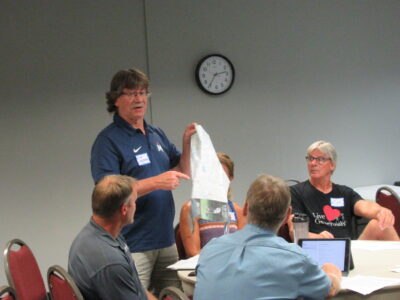
Around 24 people, ranging from members of the public to city and county officials, took part in Wednesday's work session. Newman summarized the public comments the DNR had received, and gave people at the meeting a chance to flesh out ideas for recreation and historic interpretation.
Newman said commenters had expressed interest in a variety of recreation sites along the Minnesota River, mainly in sites in Chippewa, Yellow Medicine, Redwood and Renville Counties.
"There were lots of comments about maintaining recreation opportunities," and caring for existing assets, he said. Suggestions also included expanding camping, hiking, equestrian and water access opportunities in the area, as well as preserving natural resources and the history of the U.S.-Dakota War of 1862.
People at Wednesday's work session added to those suggestions. Representatives from both Yellow Medicine and Renville County said there were opportunities to expand or develop county parks.
A number of Renville County parks located along the Minnesota River valley offer camping, fishing and horseback riding, said parks manager Jesse Diehn.
"I think we share a lot of the same users with the Upper Sioux state park," Diehn said.
"We have some concerns from the city of Granite Falls," Smiglewski said. A number of suggestions were put forward, including completing a paved trail connection between Granite Falls and Montevideo, expanding Memorial Park in Granite Falls, and developing campsites and river access on vacant city-owned land.
"We would welcome the chance to work with the Department on that," Smiglewski said.
Other discussions focused on questions like how to consider history and interpretation of Minnesota River valley sites.
Dave Craigmile, of the Wood Lake Battlefield Preservation Association, said U.S.-Dakota War sites like the battlefield could also benefit from some additional support for interpretive signs or native prairie restoration.
"Our needs are somewhat different," Craigmile said. "It's a solemn place, not for camping."
Newman said a second working session is also being planned to continue the discussion on recreational opportunities. That meeting is planned for Oct. 5, but additional details are yet to be announced.