Swedzinski, Dahms discuss ‘interesting’ 2023 session
Legislators host town hall in Marshall
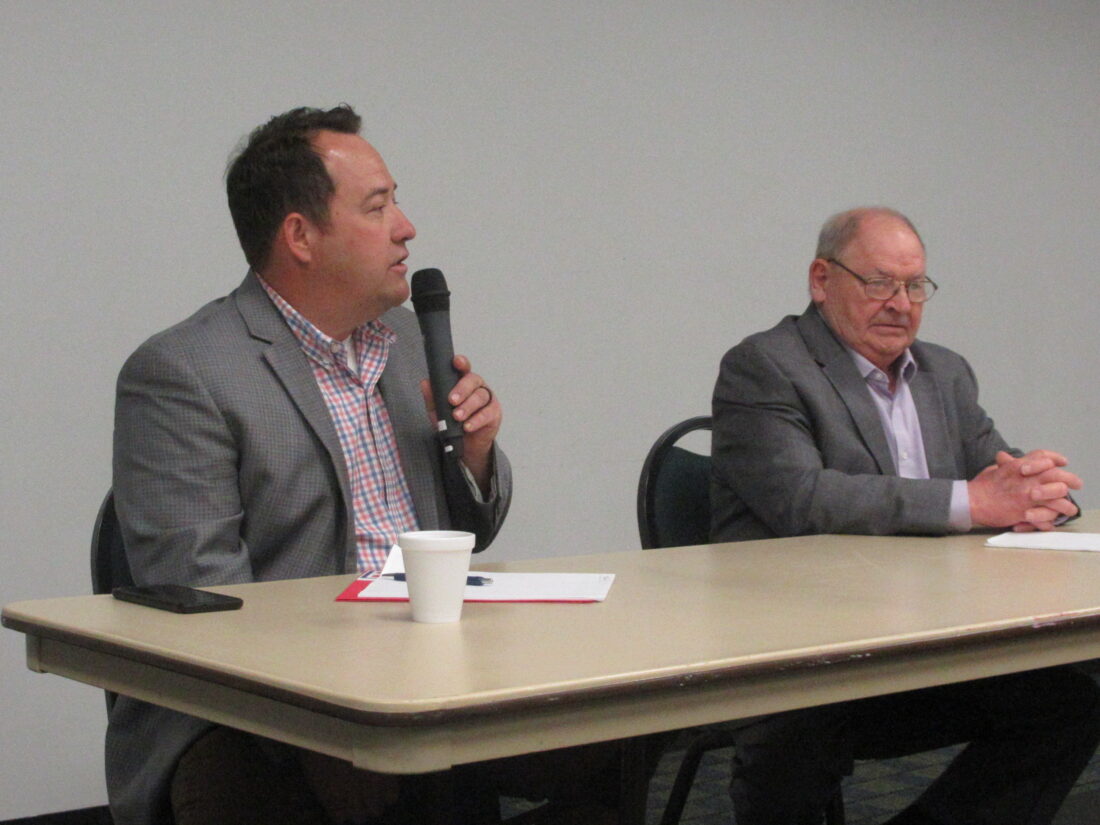
Minnesota state Rep. Chris Swedzinski and Sen. Gary Dahms took questions from area residents at a town hall meeting Thursday morning in Marshall.
MARSHALL — An audience member during a Thursday 2023 Legislative session town hall asked Sen. Gary Dahms, R-Redwood Falls, and Chris Swedzinski, R-Ghent, if they voted for the bonding bill that included funding for projects in Lyon County, including for the National Guard Armory in Marshall and the MERIT Center.
The two lawmakers gave different answers.
“I voted for the bonding bill,” Dahms said.
He said one big reason was the bill presented an opportunity to negotiate for more funding for Minnesota nursing homes. “I voted for the bill, and I will defend my vote for it, because of all the other things that went with it,” he said.
“I voted no,” Swedzinski said. “My big concern was we had, as Gary alluded to earlier, just such a giant growth in government.”
“We worked hard to get (local projects) in, but I felt it was important that we represented a common sense when it comes to spending as well,” he said.
Dahms did raise concerns about increasing state government during the town hall event at the Marshall Area YMCA. The two lawmakers held a series of town halls on Thursday.
“The session was an interesting one. Obviously, having a total DFL control really kind of hampered the efforts to limit the size of government and the amount of spending in the state of Minnesota,” said Swedzinski, R-Ghent.
“This has been a very interesting session to say the least,” said Dahms, R-Redwood Falls. “If you were listening once in a while to what was going on, I’m sure that you would hear some of the things they were talking about and wonder, ‘Where did that come from?'”
“We did have a few opportunities to do some positive things,” Swedzinski said. The list of positives included securing funding within a bonding bill for the Minnesota Emergency Response and Industrial Training (MERIT) Center in Marshall, as well as funding for area water infrastructure and facilities maintenance projects. The tax bill passed by the Legislature also included approval for the city of Marshall to hold a vote on whether to extend its local sales tax.
Dahms said another positive was the passing of the bipartisan veterans bill. “We actually had a very good veterans bill put together this year,” he said. The bill included funding to finish three veterans’ homes under construction around the state, and for construction of a veterans’ cemetery in Redwood Falls.
“One of the areas that we did fall short, pretty reasonably, was the complete elimination of Social Security tax,” Swedzinski said. “We were able to increase the amount of folks that were not liable for state taxes, but still left over 351,000 people that currently receive Social Security benefits and will continue to be taxed on those benefits within the state of Minnesota.”
The session was also marked by lots of new spending. Dahms said he had anticipated some new spending, with a $17.5 billion state surplus.
“But I also thought we’d have a pretty good strong amount of tax relief too,” he said. “What ended up happening is, it wasn’t too deep into the session and the $17.5 billion was spent. It was gone.”
“This year, if you take out the one-time spending, and just apply the reoccurring spending with tails, we have spent about $21 billion in just in one biennium. That’s over a 40% increase,” Dahms said.
Some of the comments Swedzinski and Dahms received from area residents included concerns about the “Green New Deal,” and gun legislation like the red flag law, which allows firearms to be taken away from people who are a threat to themselves or others.
Swedzinski said the push toward renewable energy would carry costs for consumers and provide less efficient energy.
“Regardless of what folks say, it’s going to be exceptionally more expensive,” he said.
Dahms said support for the Green New Deal was “pretty much split” by party. “The DFL pretty much support green energy 100%. Republicans, we understand the need for some green energy, but we certainly don’t support the extent that they’re requesting it to go to as quickly as they’re requesting,” he said.
Swedzinski said he also had concerns about the potential effects of the red flag law.
“The biggest danger that I see with that is just, it is a constitutional right to bear arms,” he said. “While we don’t want guns in dangerous people’s hands, we also believe that you should have the ability to defend yourself in a court of law. I think that’s one of the biggest concerns that we do have moving forward.”
Other questions focused on the legalization of marijuana in Minnesota. Cottonwood city administrator Teather Bliss asked if cities would be able to regulate marijuana growing operations at all.
“What you can control is the location,” Dahms said. “Anything past that is controlled by the state. If you put in an ordinance, the state’s authority will override that.”
There may also be a limit as to the number of operations that would be allowed in a city, based on population, he said.
Local News
‘We need to tell this story’
Lyon County commissioners OK permit for Vallers water tower
MARSHALL — Plans for Lincoln Pipestone Rural Water to build a water tower north of Green Valley took a step ...

Marshall to seek designs for new band shell
Marshall EDA looks at child care initiatives
MARSHALL — There’s a serious shortage of child care in Marshall and surrounding areas, Marshall Economic ...
Wild to mild