
DNR talks next steps in Upper Sioux Agency park transfer
Agency holds public feedback, Q&A sessions Thursday
Trending
GRANITE FALLS -- Transferring land from the Upper Sioux Agency State Park to the Upper Sioux Community is going to be a complex task, representatives of the Minnesota Department of Natural Resources said Thursday. One of the many steps in the process will be to find other places with potential for outdoor recreation in the Minnesota River Valley.
"The state Legislature has moved forward with the process to transfer the park, and we're going to talk about some of that legislation and what that means," said Scott Roemhildt, DNR southern region director. "The other thing, as regional director . . .I want to make sure that whatever follows the park also stays in this area, for the good of the Granite Falls area," he said.
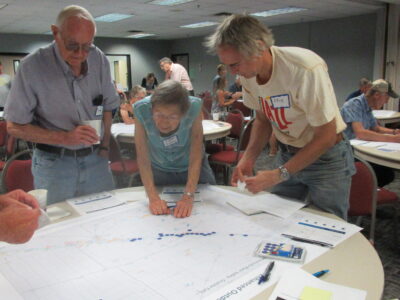
The DNR held two public engagement sessions on the park land transfer Thursday. The first half of each meeting was a moderated question and answer session on the transfer process. In the second half of the meetings, area residents were asked to share ideas to enhance or create outdoor recreation opportunities along the Minnesota River.
"This meeting is really for information, learning and discussion. It's not intended to debate legislation that has already passed," said Laura Preus, a program manager with the DNR.
About 50 people were at the Thursday afternoon engagement session.
This spring, state lawmakers passed legislation directing the DNR to start the process to transfer the Upper Sioux Agency State Park to the Upper Sioux Community. The transfer legislation has several provisions, including that the DNR submit a report to the Legislature identifying possible barriers to the transfer; and an appropriation of $5 million to facilitate the land transfer.
"With this bill, and with the money that's provided in it, we can think about new recreational opportunities that could include new land acquisitions. It could also enhance opportunities that are there, such as improving existing outdoor recreational amenities. So it's pretty open," said Ann Pierce, DNR parks and trails division director. "It does not have to be state owned or state managed recreational opportunities or land," she said.
Part of the transfer process will also involve the federal Land and Water Conservation Fund.
"At one point, we received some federal funding for work on that park," Pierce said. As a result, Upper Sioux Agency State Park has a special federal status under the LWCF. In order for the park land to change use, the DNR must go through a federal process to remove the LWCF status from the park, and reassign it to other land for public recreational use.
"That is one piece of the process we have to look at. That doesn't necessarily involve the money that was allocated in that bill. It doesn't have to," Pierce said. "If we separate them from each other, it gives us some flexibility in what we're doing in this area."
Pierce said the DNR would use public feedback on outdoor recreation to help guide their next steps in the process.
It's not yet known exactly when the land transfer will be completed, DNR representatives said. The Upper Sioux Agency State Park will remain open for the 2023 season.
Some of the questions and comments shared at the Thursday afternoon session focused on a lack of communication about the park transfer bill.
"This has all just been not very transparent," one audience member said of the process of passing the park transfer bill.
One submitted audience question asked why community feedback was not gathered before the bill was passed this spring.
"That's a real fair question. The bottom line is, we were waiting to see what was going to happen," Roemhildt said. "We were kind of in a wait-and-see mode, not only what would be proposed but what would be end up being passed by the Legislature."
In response to the audience comment about transparency, Upper Sioux Community tribal chairman Kevin Jensvold he said he met with state Rep. Chris Swedzinski in January 2021 to ask for his help in supporting the park transfer bill. The Upper Sioux Community had also made repeated requests to have the park land transferred over 18 years, he said.
Jensvold said the Upper Sioux Community were willing to be active partners in the process to find new outdoor recreation opportunities.
"The Upper Sioux Community traveled to Washington, D.C., the tribal leadership, and we secured sureties from the Department of the Interior to allow the state additional time to find replacement land," Jensvold said.
"The Upper Sioux Community, by choice and by law, are bound to this river valley," he said. "It's in our best interest to have the greatest home that we can for our children, our future generations, as well as our neighbors in the state of Minnesota. So it would be foolish not to try to protect what we have and try to promote what we have."
Jensvold said the Upper Sioux Community tribal council would decide how the former park land would be used when it is transferred. "Since it is a very new legislation, we haven't ran through all of our options as to what the future holds. But again, our position has always been that it is not a place of recreation and should never have been designated as such," he said.
More information on the land transfer process, as well as an online feedback form, is available at mndnr.gov/usasp-transfer.