A life-saving resource
Marshall Middle School staff receive Narcan training, emergency kits
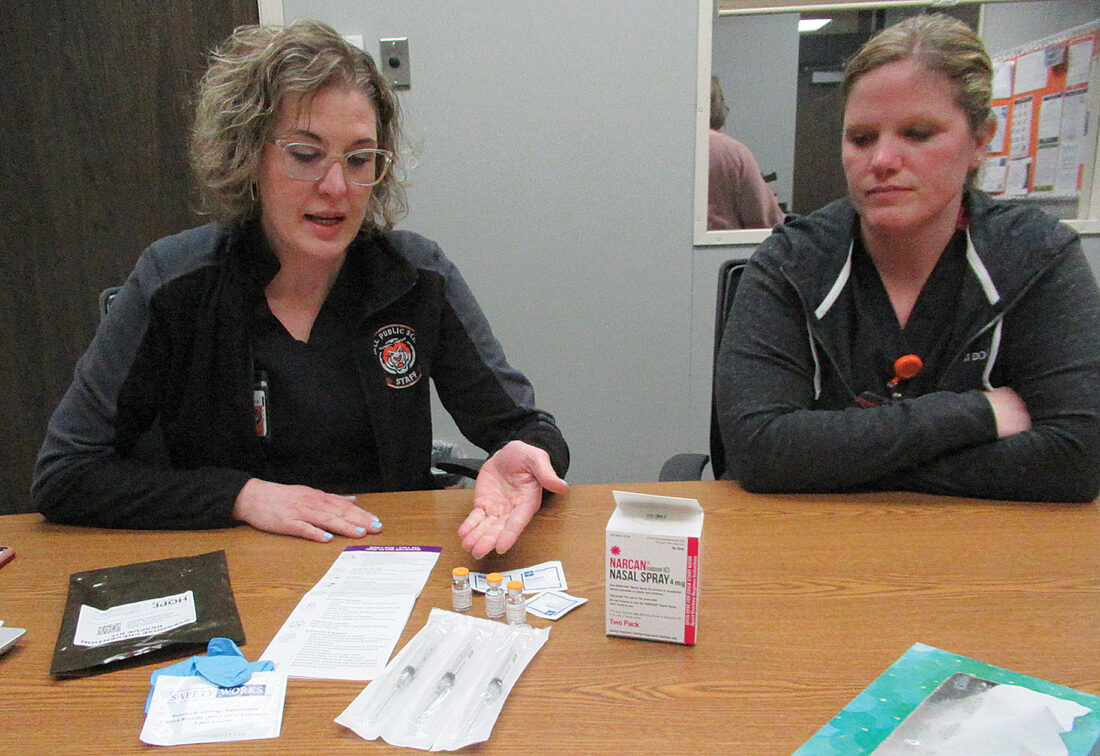
Photo by Deb Gau Marshall Middle School nurse Danielle Brandt and health office aide Erin Moline explained what was in the emergency naloxone kits that MMS received this month.
MARSHALL — Staff members at Marshall Middle School will now have access to a life-saving emergency medication. This month, MMS received kits for administering naloxone – also known as Narcan – to a person who is experiencing an opioid overdose.
It’s an important precaution to help keep students safe, said Marshall Middle School nurse Danielle Brandt.
“We’ve been talking about getting Narcan in schools for a while,” Brandt said. Opioids are a growing problem across Minnesota. “It is affecting younger and younger kids all the time,” she said.
According to data from the Minnesota Department of Health, opioids were involved in more than 900 drug overdose deaths in the state in 2021. The number of opioid deaths was up 36% from 2020, MDH data said.
“A lot of statistics were pointing toward younger people being affected by this,” said Shelly Elkington, a trainer and advocate with the Steve Rummler HOPE Network. The SRHN works to educate people about the opioid epidemic, as well as to prevent overdoses and reduce stigma.
Last week, MMS worked together with the SRHN to host a training session on naloxone for more than 60 middle school teachers and staff. MMS staff were also able to get emergency kits for administering the medicine.
“You could kind of look at it like a school having EpiPens or an AED,” Elkington said. Naloxone is another tool school staff could use in a life-and-death emergency, she said.
Nurses at Marshall High School and MMS had already set a goal of getting naloxone for their schools, Brandt said. Naloxone, which is also sold under the brand name Narcan, is a medication that reverses the effects of an opioid overdose. Marshall Public Schools has been making progress toward that goal, developing policies and procedures for emergency naloxone use. At the same time, Brandt said, another opportunity came from SRHN volunteers.
In September, SRHN trainer Herb Howell approached MPS School Resources Officer Sara VanLeeuwe about doing training with the school district, and VanLeeuwe passed on the message to the school nurses. Together with school administration and the SRHN, they organized a naloxone training session at MMS.
“It was one of the largest ones we’ve done in this part of the state,” Elkington said. A total of 65 staff members took the training, she said.
Another training session is planned at Marshall High School in April, Elkington and Howell said.
The SRHN was also able to provide MMS with naloxone kits. Each kit contains doses of the medication, along with syringes, gloves and supplies to administer it safely. Brandt said MMS health office staff will keep emergency naloxone kits along with other emergency medications like EpiPens.
MMS staff who completed the naloxone training also received kits. If they didn’t feel comfortable with injecting the medication, they could request a Narcan nasal spray instead, Brandt said.
MMS also received fentanyl test strips, which can be used to determine whether a drug contains fentanyl, a powerful opioid.
“It’s a safer way to find out exactly what a kid has in their possession,” Howell said.
Brandt said MMS will also be continuing to educate students and parents about the dangers of opioids and other drugs. The school has held discussions with students during advisory period, and have shared information in parent newsletters, she said.
Marshall Public Schools is also in the process of approving a policy authorizing the district to possess and administer naloxone for emergency use. The school district put procedures for emergency naloxone use into effect in December, and the final reading of a policy on overdose medication will be voted on at Monday’s school board meeting.
The overdose medication policy authorizes school district administration to obtain opioid overdose medication, and authorizes trained school staff to administer the medication if they believe someone is experiencing an overdose. The policy is contingent on state and federal laws permitting the district to get the medications, the availability of funding, and the school district and staff having legal protection to administer the medication.
Minnesota currently has a Good Samaritan law, known as “Steve’s Law,” which protects a person who administers naloxone and calls 911 for someone having an opioid overdose.
Brandt said it was good to be able to see the MPS nurses’ goal come to fruition.
“It really says something that the administration was willing to get behind this,” she said.
Brandt said it was also timely that the district has started looking at naloxone policies and training. This spring, a proposal to require Minnesota public schools to have a supply of naloxone also went before the Minnesota legislature. The U.S. Food and Drug Administration also recently announced that Narcan could be sold over the counter.
Elkington said more resources on preventing opioid overdoses can be found at the SRHN’s website, https://steverummlerhopenetwork.org. Howell said area groups, like the Substance Free Coalition of Pipestone, Rock, Nobles, Murray and Lincoln County, are also working to expand efforts toward opioid and substance use prevention, treatment and recovery. He said the Coalition is hoping to expand Certified Peer Recovery Specialist services in the five counties, as well as possibly starting a naloxone access point in Marshall.
Local News

‘Riding a tornado’

Celebrating Bandwagon Days
‘America 250’ series to continue at museum
MARSHALL — A series of speakers and reflections on the United States’ 250th anniversary will continue in July ...
One dead, one injured in Hwy. 68 crash
MINNEOTA — A Minneota man was killed and an Echo woman was injured in a two-vehicle crash Friday afternoon on ...
Mylan Ray says this is the last one