
Lessons from the past
School board members look inside time capsule and discover how to successfully hold building referendum
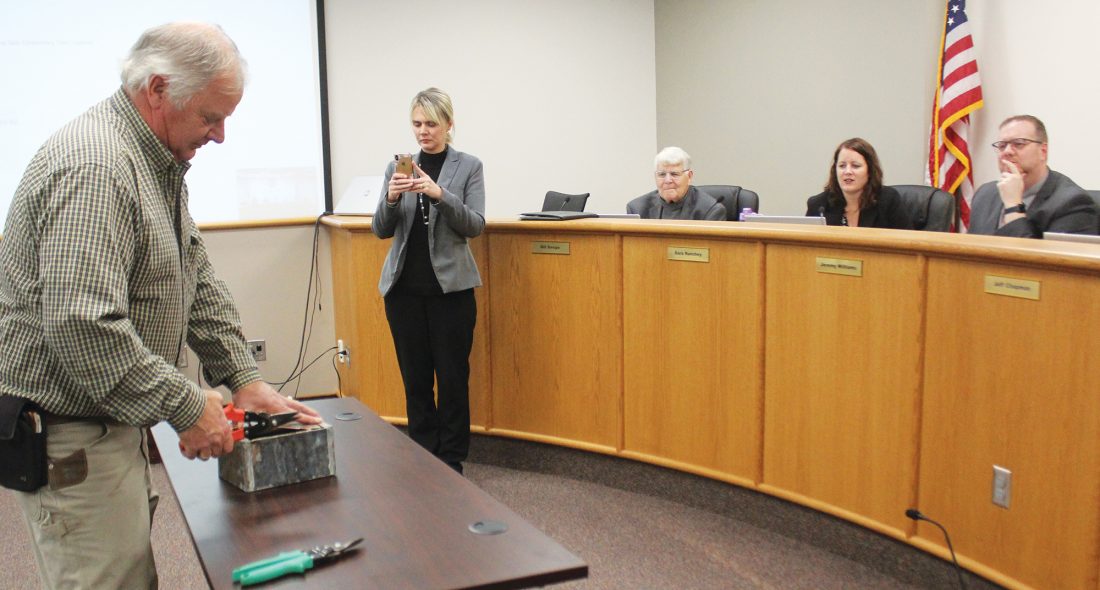
Photo by Deb Gau Marshall School Board members and school district staff watch as Warren Buchholz cuts open a time capsule found inside the cornerstone of the former West Side Elementary last month.
MARSHALL — A time capsule sealed inside the cornerstone of West Side Elementary since 1955 offered some insight into the school district’s history on Monday.
“Special bond election for $750,000, it says,” MPS Superintendent Jeremy Williams said, reading out some of the documents inside the time capsule.
“The vote was Tuesday, October 19, 1954. It passed 1,337 ‘yes’ to 533 ‘no.’ ”
At their regular meeting this week, members of the Marshall School Board watched as MPS building and grounds supervisor Warren Buchholz cut open the metal time capsule with shears.
“Look at how shiny that copper is on the inside. That’s sealed tight,” one board member said.
When Buchholz opened the time capsule, it revealed a stack of documents rolled up inside. They included a pamphlet with the results of the 1954 building referendum that created West Side written on the front.
Some things about the campaign to build West Side seemed familiar, school board members said Monday. In the 1950s, Marshall Public Schools was faced with a growing student body and a lack of space.
More than 60 years later, MPS would give those same reasons to explain why Southview Elementary needed to be built.
The time capsule was found in late December, as demolition crews from M.A.A.C. worked on the former West Side building. The capsule was inside a cavity in the school’s cornerstone, together with permits signed by some of the masonry workers who helped build West Side.
The papers found inside the time capsule outlined the planning process of West Side’s construction. The documents included a list of school board members and contractors who worked on the project, as well as concept drawings and financial statements.
Planning drawings of West Side showed that the proposed school had 13 elementary classrooms and two kindergarten classrooms. The building bond also included an addition at East Side Elementary and an addition at Marshall’s old high school building on Fourth Street to make room for industrial arts and agriculture shops.
A voter information pamphlet in the time capsule said the district had a total enrollment of 1,338 students in 1954. They expected an enrollment of 1,700 students by 1959, which was a 40% increase in high school enrollment and a 25% increase in elementary school enrollment.
At the time, East Side Elementary was full, and additional school building space on Lyon Street was also being used for classrooms. The pamphlet said the classrooms on Lyon Street needed to be cleared out to make room for high school students.
“If an additional building is not provided, it will be necessary to start renting rooms in church basements or downtown within two years at the very latest,” the pamphlet said.
The pamphlet said the $750,000 building bond would mean a property tax increase of about $9 for a property owner paying $200 a year in school taxes.
“The interest rates were between 2.39% and 2.54%,” Williams said, reading from documents on the building bond.
The time capsule also included an October 1954 editorial from the Marshall Messenger newspaper, which said the West Side building referendum was “a vote of confidence” in the school district.
School Board Chairman Jeff Chapman read from part of the editorial praising efforts to build support for the new school.
“I do say it’s kinda funny that it says here, ‘The Messenger tips its journalistic hat to (Superintendent Les) Fry and the countless other city and rural citizens who did such an outstanding job of telling the story to the people,'” Chapman said.
“It just goes to show, if you just put the facts out there and tell the story and educate the people why, the community will always pass it,” Chapman said.
Local News
Wabasso water project delayed
WABASSO — A water treatment project in the city of Wabasso is temporarily on pause due to “unforeseen ...

No one carries their cross alone

‘We try to support the best way we can’

Pieces of Marshall history get new life
United Way awards grant to Lynd Public School
LYND — Lynd Public School has been awarded a $1,000 Kindness Investment Program (KIP) grant from the United Way ...
Lyon Co. rolls out new emergency alerts
MARSHALL — The rollout of a new emergency notification system for Lyon County started this week. The Lyon ...