Vision of 1960s was superseded by rapid growth
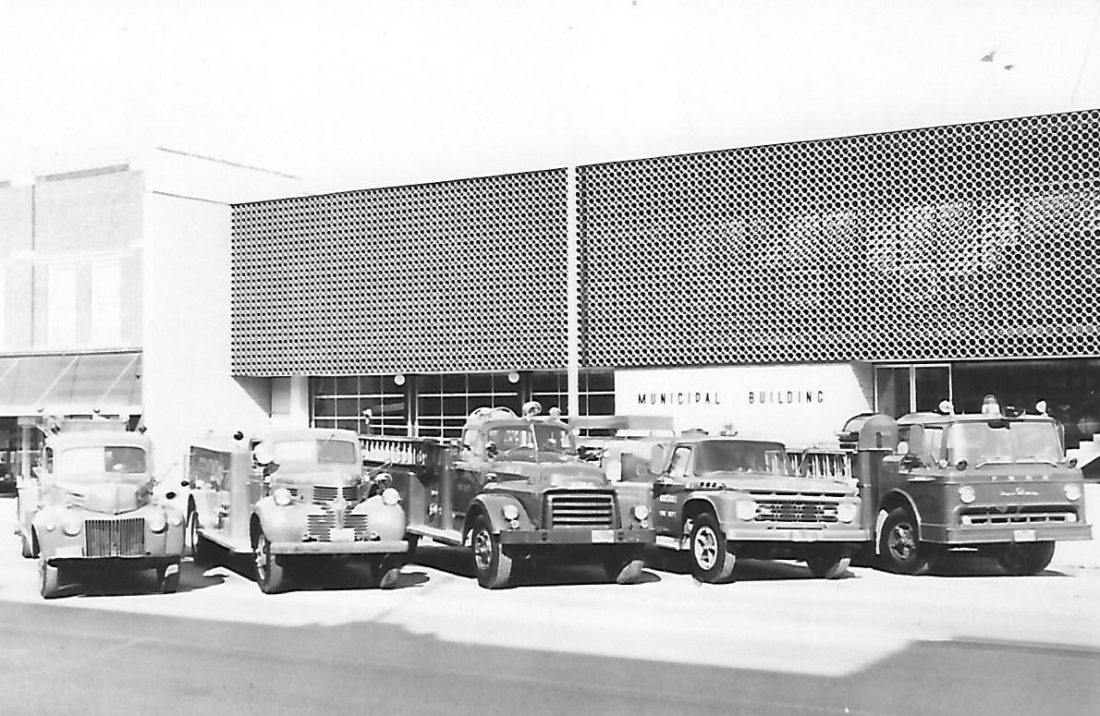
MARSHALL — City officials hoped to meet a wide range of needs when they developed plans for a modern-day Marshall municipal building in the early 1960s.
The building was constructed to house the city fire department, the city police department, a city courts center, city administration offices and civil defense activities; all in one location on part of a Main Street city block.
A new facility was needed to replace an aging city hall that was built in the early 20th century. Police and fire departments also faced needs for modern accommodations suitable for late 20th century vehicles and equipment.
A site selection process was conducted for much of 1962. Several different properties were considered, including the area of North First Street that later become the Parkview high-rise apartments. The two finalists for sites were located on Main Street and on South Fourth Street.
It was decided to let voters weigh in on the site decision. It was included in the bond issue vote of February1963 as an advisory question.
Architect Lee Stegner presented final project plans to city officials at a January 1963 meeting, which the council approved. On Feb. 19, voters approved a $195,000 bond issuance on a vote of 835 yes votes to 735 no votes. The Main Street site was favored over South Fourth Street by a margin of 770 to 529.
The bond issue was one of several components used to fund construction. A total of $200,000 in reserve funds was appropriated to the city by the Marshall Utilities Commission.
The project also benefitted from $37,500 in federal civil defense funding. The municipal building was designed to suit the best specifications of the time period for nuclear fallout shelters. Space in the building would be used for civil defense in case of an emergency, and would otherwise by used for routine business by the various city departments.
Bids opened in the spring of 1963 were below estimates at a combined total of $399,700. The winning bidders included Gunderson Construction of Minneota at $256,400 for general contracting, Wright and Ricke of Marshall at $88,540 for mechanical systems, and Moore Electric at $27,400 for electrical installations.
Additional costs included $16,616 to Otis Elevator Company for an elevator and $10,930 to Paul Jail Building Company for the construction of a jail cell.
Construction took place throughout much of 1963. The former city hall was demolished to make way for construction, along with the neighboring VFW Gunels Building and a neighboring pool hall. The Marshall Messenger reported that some extra time was needed to finalize acquisition of the two nearby properties.
A dedication and open house took place on Jan. 10, 1964. Speakers at the event included Marshall City Council President Sam Pomrantz and Marshall Assistant Fire Chief Larry Henle. Municipal Judge Bruce Pierard presented the building to Marshall Mayor George Abrahamsen.
City administrative offices occupied the top floor of the building. They surrounded a circle-shaped meeting hall used by the city council and advisory boards.
The front of the first floor housed the city clerk’s office. The back portion served as the police headquarters. The fire department had a three-bay garage for its trucks, a locker area for equipment, and basement space for a meeting room and living quarters.
The fire department outgrew its new space in less than 15 years. A campaign in the 1970s for a new fire hall was followed by a bond issue vote on Nov. 8, 1977, in which the fire hall on South Saratoga Street next to Tiger Lake was approved on a vote of 1,390 to 1,258.
The police department remained in the municipal building until the late 1990s, when the department became co-located with the Lyon County Sheriff’s Office at the newly-built Law Enforcement Center next to the Lyon County Courthouse.
The vacated space in the municipal building was occupied as a garage area for city vehicles, basement meeting rooms, and office space for a larger number of city staff. City administration was moved to the vacated police department area, which placed it on the same floor as the front city clerk’s counter.
The new city hall includes a shift in the location of city departments. First floor space was given to the city engineering and city community services offices since they have the greatest amount of foot traffic from the public. The remaining offices are situated on the second floor. A much smaller garage bay adjoins the alley between West Main and West Lyon streets.
Local News
Service Enterprises closes Marshall satellite office
MARSHALL — They had a presence in Marshall for more than 40 years, providing employment support for people with ...
End of an era for Marshall band shell
Lynd Fire Department receives grant to upgrade radios
Man charged in Balaton hit-and-run pleads not guilty
MARSHALL — A Balaton man charged in connection with a hit-and-run incident in December has pleaded not guilty to ...
Lyon County board hears request for smaller DEED office in Marshall
MARSHALL — Budget and workforce cuts have a tenant at the Lyon County Government center asking for a smaller ...