
Serie rides out tour in Vietnam with the Big Red One
Trending
LAKE BENTON -- Being drafted to serve in the U.S. Army infantry in 1968, Gary Serie recalls facing the realities of being shipped out to Vietnam.
"I didn't have a clue," Serie said while sitting at his kitchen table at his Lake Benton home. He shared his memories of his year fighting in the Vietnam War.
"They kind of indoctrinated us all into thinking you probably weren't coming home. That's how rough it was."
Serie trained to serve in the infantry, and was sent to his first base camp near Saigon thinking he would be doing a lot of walking and fighting in the Vietnam jungles. But he caught a break.
"I ended up being in the Big Red One quarter calves. And that was an armored tank unit," he said.
According to the First Division Museum in Wheaton, Ill., the 1st Infantry Division was one of two divisions sent to defend the Republic of Vietnam in 1965.
"I ended up driving big tanks. The first time I was on them I was a gunman. Then I ended up driving. We drove the M48 World War II tanks. Then ended up what they call APCs, which is an armored personnel carrier. I drove them part of the time too," Serie said.
"I don't know," Serie answered when asked why he was assigned to driving tanks.
He said he landed at the base camp with another soldier from Windom, who he didn't know before being drafted. But they ended up training together and flew on the same helicopter that took them to the field.
"And we got out there with the Big Red One quarter calves. I don't know why they didn't change my MOS (military occupation code). But that's where we ended up," Serie said.
While he admitted tanks would be big targets for attacks, the unexpected assignment was still a break.
"They were after the tanks, just like the infantry. But we didn't have to walk. And we could sleep on the tank at night off the ground.
"It was a difficult time," he said. "Once you got acclimated a little bit, I guess it wasn't what they taught us. It was bad. And being on the infantry side, the tank -- the armored unit -- made it easier. But we were still in the thick of things," he said.
"We worked with infantry a lot. We did a lot of convoy running when they would run convoys of supplies from base camp to up north to another one."
Serie shared the frustration of fighting an invisible enemy. And one that kept coming back after being chased away.
"I think the biggest thing about Vietnam, no matter where you were and what you were doing, you didn't know your enemy. You couldn't tell by looking at them," he said. "Because we had a lot of Marvins, which were Vietnam Army (soldiers) that were on our side, that helped us. But there was a lot of Viet Cong you couldn't tell the difference.
"You would go through an area and you take control of that area. Clean out and move on. Well, maybe two, three days later you would come back through that area and it was all infiltrators back. So that was probably the worst part of the whole thing."
And it wasn't just the enemy that was frustrating. He recalled temperatures reaching as high as 125 degrees during the day.
"The coldest night I ever seen was 65. And that was for one night. Otherwise, it didn't cool hardly at all. It was pretty much over 100. You kind of got used to that. It's hard to say that, but we did," he said.
When his year-long tour was done, he returned to the United States. He could have extended his tour another 90 days and be completely done with his service after that tour was completed.
"I figured I made a whole year over there without a scratch, I get the hell out," Serie said.
He was scheduled to be stationed in Germany to finish out his service, but he made some requests and was able to finish at Fort Riley in Kansas.
After his service was completed, he returned to Minnesota with his wife Shirl. While he grew up on a farm north of Ward and attended vocational school in Canby, he lived in Minneapolis working for a tractor dealer before being drafted. So he returned to that job.
But, he said, it wasn't easy.
"When you came home, you had your job that you left. They had to give you your job if you want it. And I took mind back." Serie said. "But everybody else, the job, moved on. People that were there were a little more experienced at work. The world moved on two years or three years, whatever you were gone. That was a big adjustment."
And of course, he said the Vietnam War was not like World War II.
"A lot of people were not in favor of the war. Veterans weren't accepted," he said. "One day you were just gone and then two years later you came back. No thank you for serving. Nothing like that. No big parades like they have now. You just moved back into society. And some people really struggled with moving back into society."
However, Serie said he was treated well in southwest Minnesota and up in Minneapolis.
The Series eventually returned to southwest Minnesota and owned a NAPA auto parts store for 42 years and a Hardware Hank store in Lake Benton for six years.
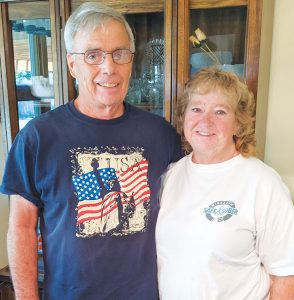
Gary and Sheryl Serie are now retired and enjoying their eight grandchildren.
Looking back, Serie said he would not change a thing.
"That time in your life I needed to go through. Glad we did," Serie said referring to his wife and parents.
"It was bad for them too," he said.
"I wouldn't have done anything different. We did what we were supposed to do. I think the military would be a good experience for everybody. Not to go to war, but I think it would be good if everybody could experience maybe six months to a year, some kind of military training like the National Guard."