
2020 — The year of the pandemic
Top stories: Major changes to our lives and dramatic election
Trending
MARSHALL -- A lot can happen in the space of a year -- and at times, it seemed like 2020 was really putting that idea to the test.
The Independent's top stories of the year include national and international events that touched, and in some cases drastically changed, life in southwest Minnesota. At the same time, area communities continued to move forward with school and municipal building projects that had been a long time in the planning.
COVID-19 pandemic comes to MN
A newly-discovered virus affecting people across the globe, from China to Italy, made its way to the U.S. in late 2019 and early 2020. On March 6, the Minnesota Department of Health confirmed the first case of COVID-19 in Minnesota. The first case in a Lyon County resident was reported at the end of March. Over the course of the year, every part of life in southwest Minnesota would be affected by coronavirus, from schools and health care to businesses.
While Lyon County heath workers started to receive COVID vaccines in late December, the pandemic is still not over.
As of Dec. 31, the Minnesota Department of Health reported a total 415,302 cases of COVID-19 and 5,323 deaths statewide. That total included over 2,700 confirmed cases among Lyon County residents, and 29 deaths.
Schools, health care providers and long-term care facilities were some of the first places in the area to respond to the
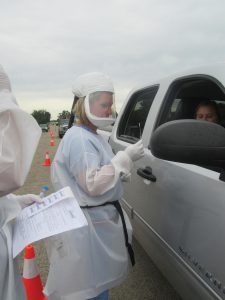
pandemic this spring. Nursing homes closed to outside visitors; schools and colleges shut down and switched to distance learning; hospitals restricted visitors and scaled back on elective medical procedures. Avera Marshall Medical Center prepped for a possible surge of sick people, identifying possible areas for additional hospital beds. Health care workers were also cross-trained to fill in at different areas of the medical center and the Avera Morningside Heights nursing home. Avera Marshall's Carlson Street clinic became the location for a drive-through COVID testing site.
Large gatherings were restricted this year to help slow the spread of the virus. The move put a temporary stop to a lot of social events, from county fairs and town festivals to attending sporting events. Area churches limited seating or went virtual for worship services. However, southwest Minnesota still saw outbreaks of COVID-19 connected to social gatherings. In August, more than 70 people tested positive for COVID-19 after attending a wedding reception and dance in Ghent.
The pandemic had an impact on the region's economy as well. Outbreaks of COVID-19 at major meat processing plants in Sioux Falls and Worthington in April left some southwest Minnesota farmers with nowhere to slaughter their livestock. Local businesses in Minnesota towns were also hurting this year, after executive orders from Gov. Tim Walz shut down types of businesses where COVID-19 could spread more easily. Gyms, indoor entertainment venues like theaters, salons and barbershops, and bars and restaurants were all shut down for at least part of the year.
In November and December, some area restaurant and bar owners started re-opening for indoor dining in defiance of the governor's orders. Larvita McFarquhar, owner of the Haven's Garden restaurant in Lynd, was sued by the Minnesota Department of health for holding an indoor gathering Nov. 27. Around 80 to 100 people gathered at an event featuring food and music. McFarquhar was found in constructive civil contempt of court when she said she would not follow a restraining order against indoor dining.
Elections bring national, local change
The 2020 U.S. presidential elections drew a lot of interest from area residents, with both Republican and Democrat supporters holding public events throughout the summer and fall. Marshall became the site of a lot of Republican-focused events, with political officials and candidates ranging from Michelle Fischbach to South Dakota Governor Kristi Noem making appearances in town. Noem's visit ended up drawing hundreds of people to Marshall, and Fischbach would go on to unseat U.S. Rep. Collin Peterson in November.
While President Donald Trump ended up losing the presidential election to Joe Biden, about 61% of Lyon County voters supported Trump, county election results said.
Perhaps the biggest local change brought by this year's election was the impact of absentee ballots on voter participation. All but 7 of Lyon County's 33 voting precincts switched to using mail-in ballots only in 2020. Additionally, a record number of voters cast their ballots early.
The county turnout for this year's election was about 90.4%, said Lyon County Auditor/Treasurer E.J. Moberg. A total of 12,948 people voted in Lyon County on Nov. 3 -- the most in over 30 years, Moberg said. A total of 7,750 absentee ballots were accepted, which is the highest number in the county's history.
Marshall City Hall renovations underway
Long-discussed renovations at Marshall's city hall got underway in 2020. The project will overhaul the Main Street municipal building built in the 1960s. The municipal building was originally a combined city office, court, police station and fire hall. However, the building had issues ranging from a boiler at the end of its life to a lack of handicapped accessibility. Years of exposure to road salt and moisture in the old police and fire garage also damaged some of the building's concrete and rebar.
The planned renovations were extensive -- in March, all the existing walls were torn out of the building, followed by work to re-pour the concrete slabs forming the floors of the basement and ground levels of the building. When renovations are complete, the main entry of city hall will be lowered to street level, and the old garage space will be converted into city council meeting chambers.
City employees had to move to temporary offices during construction, so the city of Marshall started out 2020 in part of the Social Science building at Southwest Minnesota State University. In some ways, the move was a role reversal for the university and city – back in the 1960s, the city municipal building was the first home of what was then Southwest Minnesota State College's first offices.
A new school rises in Marshall
The past year brought a lot of upheaval for local schools, but construction of a new elementary school in Marshall still moved forward, as did an expansion project at Park Side Elementary. Building a new school to replace the current West Side Elementary formed the biggest part of a $29.8 million school referendum passed by voters in 2019.
Construction of the new Southview Elementary, located along Southview Drive, started in the spring of 2020. Over the summer, cranes lifted massive panels of pre-cast concrete into place to form part of the building's walls, and by December, a lot of the structure was enclosed. The plan for the project is to have the new school ready for students in the fall of 2021, said Marshall Public Schools business services director Dion Caron.
At the same time, MPS also approved the sale of the existing West Side Elementary property to a developer with plans to demolish the building and convert the property into residential development.
House explosion kills two
Tragedy struck in the area in late August, when a local couple were killed in an explosion at their home just east of Marshall. The explosion in the early morning of Aug. 27 completely leveled the home of Gail and Nancy Schipansky, and area residents reported being able to hear or feel the blast miles away in Marshall.
Gail Schipansky, 74, was killed in the explosion, and his wife Nancy, 71, was airlifted to Regions Hospital in St. Paul. Nancy Schipansky died Sept. 2.
A report by investigators from the Minnesota Fire Marshal's Office concluded the explosion was sparked by a dryer in the basement of the house, and fueled by liquid petroleum gas that had built up in the basement from a leak in the supply line. As part of the investigation, the LP supply line on the property was excavated, and a leak was found in a repaired section of the piping. The investigation report said a new septic system had been installed at the Schipanskys' home the week of the explosion. The LP line was "most likely" hit during work on the septic system, the report said.
Long-vacant hotel demolished
Construction in 2020 re-shaped Marshall's Main Street in ways that went beyond City Hall. A long-empty hotel building dating back to the 1920s was torn down this summer. The city of Marshall had acquired the former Marshall Hotel building after the state Fire Marshal's Office had declared it a hazard. The city had explored options for redeveloping the building, but in April 2020, construction at City Hall revealed extensive water damage in the hotel walls.
"Now, knowing what we do know today, the cost would be much more to a developer than we initially thought," said former Marshall public works director Glenn Olson. Marshall City Council members voted to advertise for bids to tear the hotel down.
Demolition began in June, after the Lyon County Historical Society saved artifacts including the hotel's old neon sign. But even tearing down the hotel didn't stop the complications it posed for the city. Demolition work revealed that the hotel shared a foundation and a load-bearing wall with the Mainstay Cafe next door. The wall would have to be saved and stabilized to protect the cafe. On the other side of the hotel, demolition revealed that the east wall of Marshall's city hall was not square. Tearing out and rebuilding the city hall wall would cost the city, city staff said.
RTR school construction continues in Tyler
Construction started the fall of 2019, but a new K-12 school made lots of progress in Tyler in 2020. By August, most of the building structure was enclosed, and Russell-Tyler-Ruthton Superintendent David Marlette said the project is planned to be completed by the fall of 2021.
Voters in the RTR school district approved the $35 million building project in a February 2019 referendum. Ground was broken that year for a 150,000 square foot school building, which will serve students from pre-kindergarten through 12th grade.
While the new school will consolidate RTR's elementary, middle and high school grades together in one building, site construction manager Michael Beach said the building would still have touches that recognize each of the three communities in the RTR district. The auxiliary gym would have space for three basketball courts, and there are plans to preserve the old scoreboards from the schools in Russell, Tyler and Ruthton, he said.
Marlette said planning wasn't over for the school project. Once the new school is completed, there's still the question of what to do with the existing RTR school buildings in Russell, Tyler and Ruthton. Marlette said the school district has talked with each of the three cities, and asked for direction on what they want done with each of the old schools.
Highway 23 project brings detours, safety improvements
Traffic on a key area highway corridor was under detour for most of 2020, but the results included safety improvements that have been long talked about at intersections in Cottonwood. The Minnesota Department of Transportation closed about 18 miles of Minnesota Highway 23 this spring, for concrete resurfacing work and other updates.
MnDOT engineers said mild weather this year helped the project make progress. By the time the highway reopened in November, construction crews had added new safety features like left turn lanes at several intersections in Cottonwood, and realigned the intersection of Lyon County Road 9 so the county road was more perpendicular with the highway.
Other MnDOT projects in the Lyon County area in 2020 included resurfacing 17 miles of U.S. Highway 59 in Lyon and Yellow Medicine counties, the completion of resurfacing on Highway 91 from the Nobles/Murray County line north to Russell, and stabilizing road embankments and slopes at locations along Highway 59 and U.S. Highway 14.
Marching for George Floyd
When George Floyd was killed in Minneapolis on May 25, the news sparked mass protests all around the country -- including southwest Minnesota. In June, over 200 people gathered at Memorial Park in Marshall, carrying signs and speaking out against racism and police violence against people of color. The group marched down East College Drive between Memorial Park and the corner of Bruce Street, and held a couple of pauses for people in the crowd to speak.
There had been concerns that the protest in Marshall would lead to violence or property damage. However, the event was peaceful. Marshall Police and city staff directed traffic, while local businesses provided water for the marchers.
"We need to show support where we are, to show we're all in this together," said Jess Dressen, one of the event's organizers. Dressen said area residents came together to organize the protest on social media.
While marchers said it was good so see so many people take part in the Marshall protest, they said it couldn't end there.
"This should not be the last place you talk about this," one speaker told the crowd. "There will be no more racism among us. Can we agree on that? We will hold the police accountable for what they do to us. Can we agree on that?"
Rainbow flag controversy puts spotlight on Marshall
The inclusion of a rainbow LGBTQ pride flag in a display of flags at Marshall Middle School sparked a controversy that turned statewide attention on the community in early 2020. For weeks, meetings of the Marshall School Board were standing room-only, as members of the public weighed in on the flag display. Marshall Public Schools officials said the flags in the middle school cafeteria were meant to represent different backgrounds of students at the school, and included flags of several different countries, as well as the U.S. and Minnesota state flags.
Supporters of the rainbow flag said it helped LGBT students feel safe at their school, while other community members said they felt their values weren't being represented by the inclusion of the flag. During the forum, an eighth-grade student at MMS claimed the school was stopping expression of opposing views on the flag. Minneapolis-based attorney Bill Mohrman said MPS was opening itself to a possible lawsuit from a group of Marshall community members. Mohrman said the district needed to have a "viewpoint-neutral" policy on displays at its schools.
A lawsuit did not come in 2020, but in June the school board approved a statement on the flag display. Board members said they would not be taking further action on the flag display. The school board won't be acting on any community requests or requests from outside the school to hang additional flags or take further action, the statement said. At the same time, the statement said, "We will continue to welcome the community's input."
Under school board policies, MPS "welcomes and provides equal educational opportunities for all students, regardless of race, color, creed, religion, national origin, sex, marital status, parental status, status with regard to public assistance, disability, sexual orientation, or disability," the statement said.
The school board's statement said the hanging of the flags at MMS was consistent with those policies, and was considered "governmental speech" under the law. MPS did not create an open forum for all speech in the school, and the district has the authority to decide what official speech it will make, and what flags or signs it chooses to display in schools, the statement said.