
Ag in the spotlight
About 250 attend Peterson town hall on agriculture issues
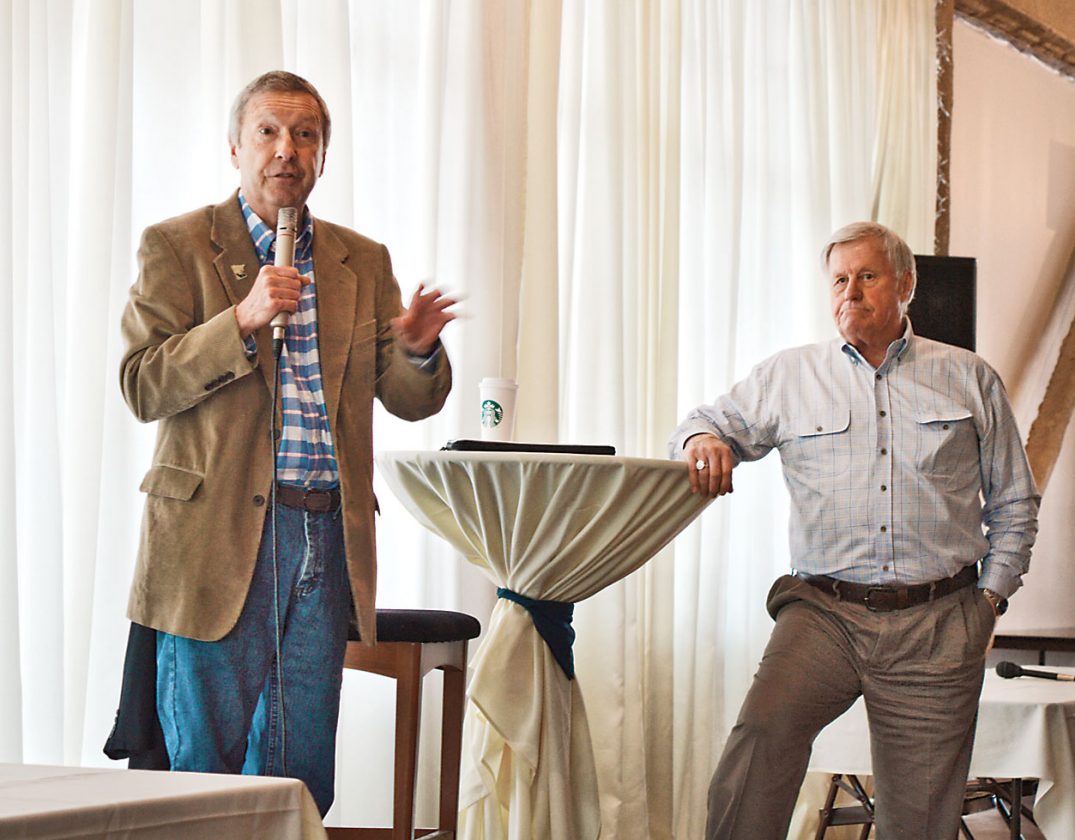
Photo by Karin Elton Lynn Ketelsen of the Linder Farm Network says a few words prior to U.S. Rep. Collin Peterson’s remarks about the farm economy. Peterson talked about the farm bill and farmer assistance programs Thursday morning in Marshall.
MARSHALL — To plant or not to plant, that is the question.
U.S. Rep. Collin Peterson, D-Minn. says “plant. Your payment is going to be based on what you plant. If you don’t plant you’re not going to get this payment.”
The “payment” Peterson, who is the House agriculture committee chairman, was referring to is the Market Facilitation Program.
Many farmers hindered by spring rainfall face the choice of deciding whether to plant a crop or exercise prevented plant crop insurance coverage. Depending on where farmers live, that choice is quickly approaching. In southern Minnesota, today is the final planting date for corn and June 10 for soybeans for crop insurance purposes.
Peterson was the host of a town hall Thursday morning on agriculture issues in Marshall. The meeting took place at Bello Cucina which was set up for around 200 attendees and another 50 or so showed up.
Before Peterson spoke KMHL News Director Aaron Ziemer, who moderated the meeting, took an informal poll of the audience asking how many farmers have planted their crops. Most of the attendees in the room raised their hands. Ziemer then asked how many had all of their crops in the ground and virtually no one held up their hand.
Peterson said he couldn’t give specific numbers of payments per acre.
“I know that you want to know the specifics so you can make your decisions but unfortunately I’m probably going to disappoint you. I’m not going to be able to tell you exactly but I can give you some indication of where this is headed,” he said.
With that, Peterson backed up and talked about the farm bill, a large, multifaceted piece of legislation, renewed by Congress roughly every five years, that shapes federal food and agricultural policy.
Peterson is having a difficult time in Washington, D.C., getting the right people to listen to his decades-long agricultural experience.
“I tried to get these guys to improve the safety net of the farm bill,” he said. “I argued throughout this last year that ‘this farm bill is not going to be adequate for what we’re facing.’ And I think people now see that I was right.”
Peterson said it was difficult to pass.
“I was kind of the lone voice in that process. I guarantee you this, If I hadn’t been at that table, we would not have had a farm bill today, I can tell you that for a fact,” Peterson said. “I had to swallow a bunch of stuff I didn’t wanna do and they had to swallow stuff they didn’t wanna do.”
Peterson said “So anyway, we had the Democrats on board and even the Republicans were on board except for the (House) Freedom Caucus.”
After a last-minute glitch which was soon sorted out, “we got the thing done and it was a damn miracle,” he said. “It’s not the best, but at least we have something we can count on.”
Peterson then talked about the Market Facilitation Program, which assists “farmers hurt by trade disruptions prompted by unjustified foreign retaliatory tariffs on their products,” according to the USDA website.
“Somebody has convinced their economists and the leadership at the USDA that it doesn’t affect planting decisions,” he said. “So they came up with this scheme. I told them, ‘You guys are making a huge mistake. All you have to do is wait three weeks,’ (so that it didn’t factor into growers’ decisions of what to plant.) But they got it into their head that they gotta do this formula. Even (Sen. R-Iowa) Chuck Grassley agreed.”
Peterson said it would take a “world-class economist” to figure out the program, but “the one thing I can tell you for sure is that this is going to be based on planted acres.”
President Donald Trump has authorized USDA to provide up to $16 billion in programs, which is in line with the estimated impacts of unjustified retaliatory tariffs on U.S. agricultural goods and other trade disruptions.
“I had nothing to do with this. This is completely the administration,” Peterson said.
“We’re borrowing money from China to fix a problem we created originally,” he said.
“Another wrinkle is the disaster bill that’s been going on for the last six months at least,” he said. “It’s for the south — if you think you’re in trouble, you are not nearly in trouble the way people from Georgia, Alabama and Florida are because of what’s happened to them the last three years. This disaster bill — they needed it in February, January. I would say 25 percent of those farmers are out of business because we didn’t get this done.”
The Senate passed the bill on May 23, and congressional leaders from both parties agreed to approve the measure in the House through unanimous consent to speed up the process, Peterson said.
“(House Speaker Nancy) Pelosi, to her credit, agreed to it,” he said. “So did (Kevin) McCarthy on the Republican side. But then Chip Roy (R-Texas) of the Freedom Caucus — he used to be Ted Cruz’ chief of staff if that tells you anything — objected. And then this (Thomas) Massie of Kentucky objected.”
But Peterson said the disaster bill should be passed soon.
The Midwest is different from the South, he said.
“A lot of families didn’t have crop insurance,” he said. “Our part of the world, everybody has crop insurance.”
“Another wrinkle,” Peterson said — the Market Facilitation Program payment, the per acre payment, goes by the historical record of the county.
“I can guarantee you that these payments will be significantly different from county to county,” he said. ”
The figure is still up in the air.
The bottom line, Peterson said, is “whatever you do, you’re gonna wish you made a different decision.”
Peterson said he hopes he is wrong, but the agricultural economy will be as bad “as it was in the ’80s.”
People in the audience mentioned today’s economy was similar to the 1980s as well including Bob Worth of Lake Benton.
“I’m a farmer and also the mayor,” Worth said. “I’m concerned about the fertilizer guy, the feed guy. Small towns will be wiped out if there is no extra money. This is the sixth year of agriculture really suffering.”
Peterson agreed.
“I know companies that still have all their fertilizer sitting in the bins. There’s not going to be any money for them. I was here in the ’80s. I think next winter is going to be hell on wheels for bankers, but we’ll do the best we can,” he said.
Local News
Lyon Co. awards housing aid to area projects
MARSHALL — Earlier this month, Lyon County commissioners heard three different proposals to help with housing ...
ATV trail grant sparks discussion
Plum Creek director highlights need for digital services
Eats & Beats, Juneteenth events return this week
MARSHALL — This week, there will be a few different opportunities to get outside and enjoy food and community in ...
Minor injuries reported in Marshall crash
MARSHALL — One person was injured in a two-vehicle crash in Marshall on Monday night. The crash was reported at ...
No newspaper on Friday
Due to the federal Juneteenth holiday there will be no mail delivery on Friday, and the Independent will not ...