
Sandy Hanson — COSTUME CREATOR
Adding flair to Opera House productions
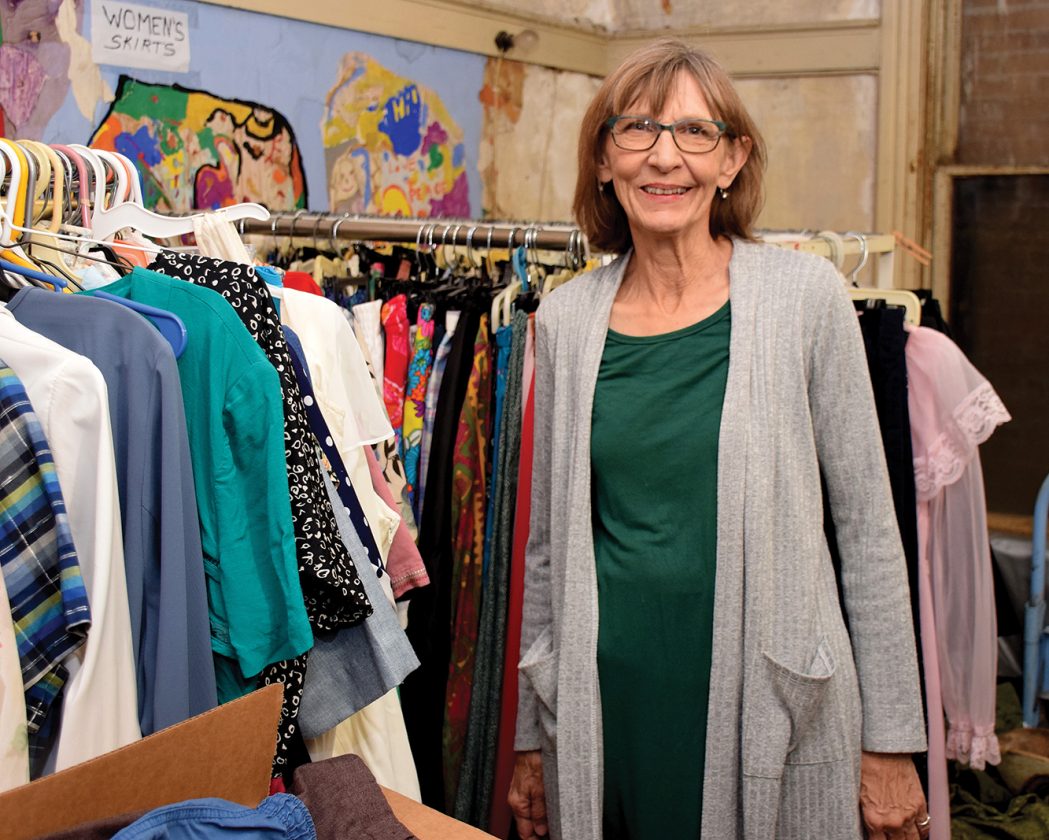
Photo courtesy of Mark Wilmes Sandy Hanson of Tyler coordinates costume selection and design for the Lake Benton Opera House. After outfitting everyone for the 2019 spring play, she looks forward to assembling Shrek costumes for the 2019 summer musical.
LAKE BENTON — Sandy Hanson specializes in making sure that everyone is dressed for the occasion.
She’s coordinated costume planning for performances at the Lake Benton Opera House, which hosts several community theater productions each year along with a variety of other entertainment attractions.
She’s currently putting together the finishing touches for the Opera House spring play, the classic “Arsenic and Old Lace,” scheduled for April 5-7 and 12-14. It will be followed by the challenge of creating apparel for “Shrek,” the 2019 summer musical.
Hanson, who works at the Tyer office of Buffalo Ridge Newspapers and lives in Hope Township, Lincoln County south of Tyler; has been in charge of Opera House costume work for the past 10 years. She graduated from Duluth Central High School, served in the U.S. Air Force, and then went to college at Bemidji State University before moving to southwestern Minnesota.
She began volunteering at the Opera House because of the success she’s had in public speaking. Her first role was that of a bellboy in the play, “Suite Hearts.”
She took an interest in the costume side of theater productions because of a talent for sewing, one that dates back to her childhood.
“I come from a family that sewed,” Hanson said. “We made costumes for everything from Halloween to horse shows. I’d gotten fairly good at it, so I decided I’d enjoy the challenge of applying my sewing skills to theater.”
She said that her general sewing skills have stayed about the same in the past 10 years. She’s learned much more, however, about what it takes to have the right kind of costumes for stage productions, costumes that blend well with scenery, stage lighting and special effects.
Part of the process involves an overall vision for how costumes should complement each other instead of looking at each character’s apparel as an individual decision.
“I make sure nobody sticks out like a sore thumb,” she said. “It’s rare that we’d deliberately do it that way. It only happens when the script calls for it.”
Another important skill with costumes is the ability to improvise. Although the Opera House has a large storehouse of clothing and accessories that can be matched together in a multitude of ways, it’s often necessary think outside the box by sewing material from several places together in a way that leads to the right appearance.
Sometimes it can mean that a costume in the inventory is sacrificed in order to become a component of a newly created costume that’s needed for an upcoming production.
“It’s not unusual for a frumpy old dress to be turned into fabric,” Hanson said. “We recycle whenever that’s the best alternative. By using imagination, it’s possible most of the time to make items ourselves instead of paying the cost to purchase them.”
The entire process of costume development has to take place within about a month. Hanson always looks through the inventory when a play is first chosen in order to get ideas.
It’s not possible to handle most of the details ahead of time, however, since she doesn’t know the size measurements for cast members.
“There’s only a limited amount of time to make decisions, but it’s always important to consider how costume quality influences acting,” she said. “Performers should feel good about what they’re wearing. It’s part of what it takes to make them ready to give their best possible performance.”
Her favorite moment with each new Opera House production happens at the end when the curtain goes up. At that point, she gets to see the full effect of many hours of costume planning as characters appear together on stage.
She also notices how all elements of play production fit together for a performance that will be enjoyed and remembered by audience members as well as everyone who helped to turn a script into a successful show.
The results have always been satisfying” she said. “The Opera House continues to get good results because many people volunteer their time and talents.”
She said summers always lead to a large group of children and teens who want to perform and to learn about skills used in the production process.
More options for lighting, set design and sound effects are possible because of 21st century technology.
Lake Benton Opera House President Mark Wilmes also serves as a director, producer, marketer and grant writer.
He volunteers for the Opera House in addition to his work as the Buffalo Ridge Newspapers managing editor.
He said Hanson has been a vital part in taking costume development at the Opera House to a higher level, one that enhances all other areas of putting together each production.
“Until we had Sandy, costumes were an area where we often had to go out and look for people who could help,” Wilmes said. “It’s a huge part of what it takes to have high quality. Having somebody like Sandy who takes a leadership role with costumes takes a huge amount off the director’s plate.”
He said the 2018 summer musical “Footloose” was an example of a performance that had clearly defined 1980s costume guidelines, similar to how “Arsenic and Old Lace” has to fit reasonably within its approximate time period.
Sometimes productions call for imagination and creativity. Even when many different options could work, a carefully planned and well coordinated set of costumes adds to the visual impressions a cast can make in front of its audiences.
“This summer ‘Shrek’ will be more like our 2017 musical ‘Beauty and the Beast,'” Wilmes said. “Those kinds of musicals aren’t as strictly defined in terms of costumes, but it’s important to make a strong visual impression. We’re confident that Sandy will come up with ideas that help to create it.”
Local News
Wabasso water project delayed
WABASSO — A water treatment project in the city of Wabasso is temporarily on pause due to “unforeseen ...

No one carries their cross alone
‘We try to support the best way we can’
Pieces of Marshall history get new life
United Way awards grant to Lynd Public School
LYND — Lynd Public School has been awarded a $1,000 Kindness Investment Program (KIP) grant from the United Way ...
Lyon Co. rolls out new emergency alerts
MARSHALL — The rollout of a new emergency notification system for Lyon County started this week. The Lyon ...