
Kids learning agriculture
350 area students attend Ag in the Classroom sessions
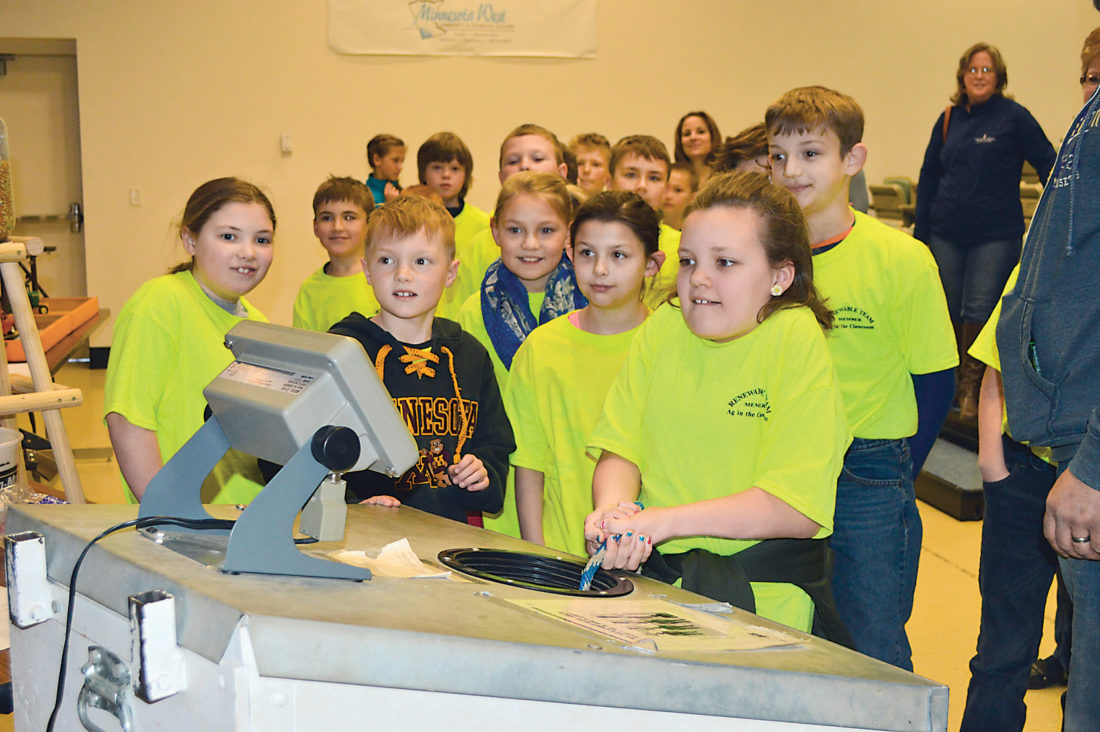
Photo by Jenny Kirk As her True Light Christian School friends wait their turn, Willow Hoff gives it her all on the grain pull during the farm safety session of the 2017 Ag in the Classroom event on Wednesday at Minnesota West. Including the 22 third- and fourth-graders from True Light, there were 175 elementary school students at the event on Wednesday — along with 175 on Tuesday — for a total of 350 students this year.
GRANITE FALLS — For the first time in its 25-plus year history, the Yellow Medicine County Ag in the Classroom event was split into two days — Tuesday and Wednesday — at Minnesota West Community and Technical College in Granite Falls.
Event co-chairs Roger Dale and Carl Louwagie were pleased with the continued growth of the elementary student program and felt that the large number of students wanting to attend and learn about agriculture was a good problem to have.
“Last year was the biggest we’d had before and that was 280,” Dale said. “This year, we’ve got over 350 kids.”
Louwagie said that the switch to a two-day event resulted in having less kids per day at the college, but that they were also able to serve more students overall.
“Hopefully their takeaway from the day is that they realize where their food comes from and that it’s all pretty much grown in their own backyard,” Louwagie said. “There are a lot of kids that live in the rural area but aren’t necessarily involved in the day-to-day agriculture.”
On Tuesday, students from Yellow Medicine East, Dawson-Boyd and Lac qui Parle Valley had the opportunity to learn at the nine different stations: farm safety, REC Electricity, turkey, soybeans, corn, beef, dairy, pork and conservation.
“I’m having a good time,” St. Edward fourth-grader Airyn Chandler said. “We’ve been learning about dairy and pork and some things about these zebra mussels getting on boats and then going into the lakes.”
Chandler’s favorite part of the experience was the electricity show.
“It was like farm safety and then they did the electricity thing,” he said. “He touched the ladder to a little wire and it sparked.”
St. Edward students, along with students from St. Peter in Canby, True Light Christian School in Marshall, Clarkfield Area Charter School and Lakeview Elementary in Cottonwood, took part in Ag in the Classroom on Wednesday.
“It’s the first year that Lakeview students have been back for quite a few years,” Dale said.
There were a total of 53 Lakeview students — all fourth-graders — in attendance. Rachel Timm said she had been learning a lot throughout the day.
“My favorite was learning about corn,” the fourth-grader said. “I learned that it’s in a lot of things.”
After attending the farm safety session, Timm said she also learned that you “don’t play around corn bins.”
The father and son duo of Gene and Robert Stengel used impactful stories, demonstrations and photos to teach the students about farm safety.
“Farming is a way of life in Minnesota,” Gene Stengel said. “We need farmers to feed the world. There are many ways to be hurt on the farm, but there are many ways to prevent accidents, too. When you’re around farm equipment, you have to be safe.”
Robert Stengel talked about grain bin safety, noting that a person could be sucked down into the grain “in a matter of seconds.”
After the presentation, some students had the chance to try the grain pull to measure how much weight they could pull.
At the corn station, Mitch Brusven was festively clad in a long-sleeved shirt covered with corn cobs, while Doug Albin wore a corn-covered tie.
“I wear this shirt just once a year,” Brusven said. “I’m with the Yellow Medicine Corn Growers Association.”
Albin said he wears his corn tie every time he goes to the Minnesota Capitol or whenever he has a Corn Growers event to attend.
“I actually sit on the Minnesota (Corn) Research and Promotion Council and farm not too far away from here. When I get the chance to go to St. Paul or Washington, D.C., I don’t want to be confused with the other groups.”
The two volunteers first shared information with the students about the growing process, followed by the harvesting operations.
“Moisture and sunlight produces the plant,” Albin said. “If it’s got sunlight and moisture and it’s well-fed with nutrients, the corn can grow (a foot tall) in five days.”
Then the presenters spoke about the many uses for corn.
“Corn is made into food for you to eat and other things for you to use, like charcoal, pop, gasoline, baby powder, corn oil for cooking, cereal and animal feed,” Brusven said. “The bags you have are also made from corn, as well as clothing and this blanket.”
“You’d be surprised how many things you can make with corn, including the tires on the school bus that brought you here (Wednesday),” Albin added.
Cottonwood teacher Darles Lamfers sparked the idea for Ag in the Classroom when she asked Roger and Joanne Dale to come into her classroom many years ago.
“We had this soybean display with different food stuff set up at the Hanley Falls Elevator for the annual meeting,” Roger Dale said. “She asked if we’d bring it to her classroom, so we did. And then the next year, she says, ‘Will you bring it, but would you also talk to the kids about soybeans.’ Then a couple years later, Doug Albin came along with corn, and it’s been escalating every since.”
When it got too much to travel to different school to teach agriculture, the decision was made to have the students come to them. So for many years, Ag in the Classroom was held in Clarkfield.
While much time has passed, the majority of the presenters at the educational event have remained the same.
“Most of the presenters have been here for over 20 years, including Jane Remiger (dairy), Carolyn Olson (pork) and Doug Albin (corn),” Lamfers said.
“I was trying to figure out what year we started. It’s been 25 years since the Lakeview School has been Lakeview — 15 years for the new school building. I found this (Wood Lake News) newspaper clipping from back in 2000. It had already outgrown my classroom and we were in Clarkfield for sure by then.”
Three Canby High School students — Becca Kallhoff, Tyler Goplen and Marissa Hanson — have been the newest presenters added to the schedule. Though younger than most of the presenters, the trio were quite knowledgeable.
“I’m a senior at CHS and this is my fourth year doing this — being a beef ambassador or a beef spokesperson, which is the same thing,” Kallhoff said. “I’m a four-sport athlete, the vice president of FFA and the president of my 4-H club. I’ve been in 4-H and showing cows for 12 years now.”
Hansen, a sophomore, said this was her third year as an ambassador and her seventh year in 4-H.
Goplen, also a sophomore in his third year as an ambassador, has showed cattle for 4-H for 10 years. He’s also currently the president of his 4-H club.
“We’re going to start off with a slideshow that has different breeds of cows,” Kallhoff said. “At the left, there is a list of them: Charolais, Angus, Hereford, Shorthorn and Longhorn. If you look at the picture and think you know which breed it is, raise your hand.”
After the students eventually categorized the cattle, they asked them if they knew what the Longhorn’s horns were used for.
“Things to put on your car for looks,” St. Edward fourth-grader Hunter Antony said.
Goplen admitted that his answer would qualify as something that could be used as a byproduct, but then he clarified that he meant while the Longhorn was still living. After guessing protection and balance, the students learned an interesting fact about the breed.
“You know how it’s hot in Texas, right?” Goplen said. “The horns on a long horn kind of do the same thing as a radiator in a car. It keeps them cool in the summer. It pumps the blood through the horns and it cools off the blood and returns it to their body. It cools them down in the summer.”
After talking about each breed specifically, the three presenters questioned the students about cuts of beef, followed by fodder for cattle.
Along with hay and corn, cows also eat silage, which Antony knew a lot about.
“It’s like chopped up corn,” the fourth-grader said. “You cover it up, so it gets fermented. It gets warm.”
Fellow schoolmate Alex Hoffman responded to the trio’s question about the difference between silage and regular corn you see in the field.
“For the corn, you combine it, and the silage is with the chopper,” Hoffman said.
Along with the organizers, presenters and students, 18 FFA members from Yellow Medicine East were in attendance to help move students to each of the 20-minute sessions.
“It’s fun,” FFA members Cole Richter and Koltyn Louwagie said.
Local News
Answering the call
Cattleman of the Year: ‘It’s an honor’
Avera, Sanford release most popular baby names from 2025
MARSHALL — Liam and Emma were many people’s top picks for baby names over the past year, according to area ...
Marshall seeks grant funds for ‘mini roundabout’ project
MARSHALL — A planned street project in Marshall would replace a stoplight on Country Club Drive with a small ...
40 years of giving
