
Author offers the full story on black history
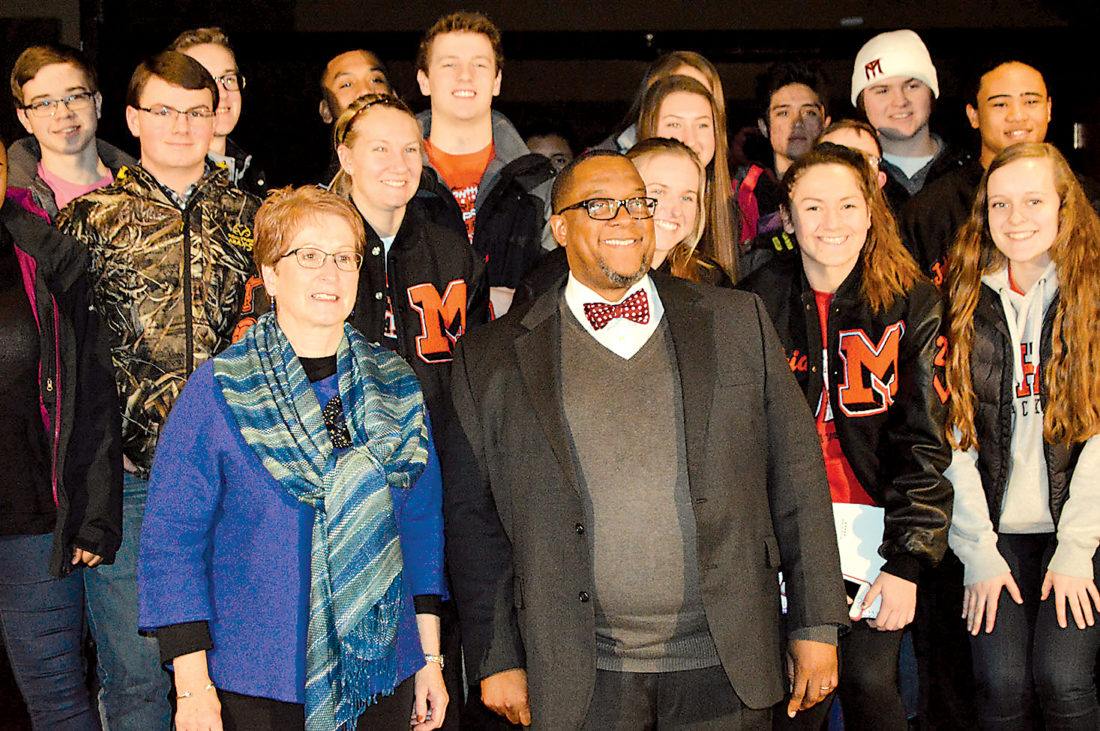
Photo by Karin Elton Rhodes College history professor Charles McKinney stands next to Southwest Minnesota State President Connie Gores with a Marshall High School cultures class behind them. The students and others attended McKinney’s presentation about black history Thursday afternoon at SMSU.
MARSHALL — All the while America’s founding fathers were extolling freedom from British tyranny and wanting no longer to be enslaved, they were owners of people. Most history books gloss over that piece of American history, said an expert on black history.
Charles McKinney spoke Thursday afternoon on “The Utter Necessity of Black History” at Southwest Minnesota State University as part of Culture Shock, a three-day festival of education and entertainment. McKinney is the Neville Frierson Bryan chair of Africana Studies and history professor at Rhodes College in Memphis, Tenn.
McKinney told the audience, which included a couple of college history classes and a cultures class from Marshall High School, SMSU staff and community members, that it’s hard to condense 400 years of history into a one-hour presentation, “but I will hit on a couple of things.”
He started by talking about the originator of Black History Month, Carter G. Woodson, who earned a doctorate, a Ph.D., from Harvard University.
“He was the second African-American with that distinction from Harvard,” McKinney said. “He created something called Negro History Week in 1926.”
Woodson said, “‘No one can be thoroughly educated until they learn about the American Negro as they learn about other people.’ Let’s think about what that meant in 1926,” said McKinney.
The year 1926 America was in “the midst of segregation, racial division. Lynchings — the systematic execution of African-American men, women and children was at an all time high. In the American South, an African-American was lynched at the rate of one a month.”
Segregation was the law of the land, he said.
McKinney said it was against the law in South Carolina for “Negroes and whites to play checkers together.” In southern states, there were separate electric chairs. In South Carolina there were separate Bibles for people to swear on, In Washington, D.C., pet cemeteries were separated by the race of the pet owner.
“Segregation was woven into the fabric of American life,” he said.
McKinney said according to Woodson, “there’s more to the story than simply slavery.”
By not including African-Americans, Indigenous Americans, immigrants and women in history books, it “diminishes our understanding of how we got to be who we are,” McKinney said. “When history extols the virtues of particular groups of people, we are all diminished.
“We can point to histories that are still excluding all manners of people. A history textbook called ‘The American Pageant’ says that America had “so few natives that they can be eliminated or pushed aside.”
McKinney said that inclusive histories are “more nuanced, richer and more interesting.” He mentioned the movie, “Hidden Figures” which is about the astonishing fact that the National Aeronautics and Space Administration not only employed African-Americans, but African-American women in 1961 and 1962.
“There are so many stories to be told,” he said.
Another example of losing the complexity, the full story, of history is at the beginning of America’s separation from Great Britain, when men said “Give me liberty or give me death,” there were 50,000 Africans living there at the time. It was the beginning of the “construction of a slave society. It was the simultaneous construction of freedom and unfreedom.
“To ignore these realities is to create a faulty foundation,” he said.
In 1620, the first slaves arrived so by 1776 there were five generations of enslaved Africans. Thomas Jefferson, who said “all men are created equal,” was the owner of 220 people.
“People say, ‘oh, he was a man of his times,'” McKinney said, but his neighbor freed his slaves and sent Jefferson a letter urging him to do the same, even though it would cost him economically, but Jefferson said he couldn’t do it.
Local News
Wabasso water project delayed
WABASSO — A water treatment project in the city of Wabasso is temporarily on pause due to “unforeseen ...

No one carries their cross alone

‘We try to support the best way we can’
Pieces of Marshall history get new life
United Way awards grant to Lynd Public School
LYND — Lynd Public School has been awarded a $1,000 Kindness Investment Program (KIP) grant from the United Way ...
Lyon Co. rolls out new emergency alerts
MARSHALL — The rollout of a new emergency notification system for Lyon County started this week. The Lyon ...