
Using more tools in the weed management toolbox
Extension educator in crops
Weed management tools can be divided into three main categories: mechanical, cultural, and chemical. Historically in conventional systems, chemical control options, or herbicides, have been relied on heavily.
Herbicide-resistant weed populations, however, are limiting herbicide options and effectiveness in many fields. Cultural and mechanical control tactics can help make systems more effective and durable, and considering weed biology is a key step in developing a successful program.
Account for weed emergence patterns:
Weed emergence is driven by a number of factors, including temperature, light, nitrogen and/or chilling period, depending on the species.
For example, giant ragweed is one of the first weeds to emerge in a season, typically emerging over a two- to three-week period. Delaying soybean planting until May 19 in University of MN trials at Waseca in 2016, for example, resulted in a removal of 55 percent of giant ragweed emergence by tillage at planting. Although average soybean yield potential was about 97 percent of optimal at this time, the benefit was a much lower population of giant ragweed to control postemergence.
In contrast, waterhemp emerges later in the season, typically emerging over an eight- to 10-week time period. This is why residual herbicides, even the layering of residual herbicides (i.e. an application at planting and then 30 days later) is recommended for control of waterhemp.
Manage the weed seedbank:
Seed production of weeds can vary significantly by species. Giant ragweed, for example, averages around 10,000 seeds/plant, while waterhemp averages over 350,000 seeds/plant. Considering that weed seeds can remain viable in the soil for years, one year of poor control can lead to significant weed control challenges for years to come.
Common lambsquarter is a long-term survivor in weed seedbank, and according to the University of Michigan, it would take an estimated 78 years to see a 99 percent depletion of the seedbank. In contrast, University of MN research demonstrated that the giant ragweed seedbank could be depleted 97 percent in two years, and University of Illinois research found the waterhemp seedbank could be depleted by more than 99 percent in four years. This shows that populations of giant ragweed and waterhemp could be dramatically reduced if weed seed production was prevented for two to four years, respectively.
Burial of seed by tillage can increase longevity in the seedbank, while seed left on the soil surface can be lost to predation and decay. For this reason, delaying tillage as long as possible in areas where weeds went to seed could help reduce long-term weed management challenges by decreasing the number of seeds deposited back into the seedbank.
Hand roguing of weed escapes can help prevent replenishment of the seedbank, but target pulling before viable seed is produced unless you plan to carry out the plants. Species vary in how long it takes to form viable seed and research by Bell and Tranel (2010) found that waterhemp could form viable seed 7 to 12 days after weed pollination. Seeds may also still mature on pulled plants if the plant pollinated before pulling. Regardless, not running the combine through a weed patch will help limit the spreading of weed seeds throughout the field.
Other tactics:
Ensuring the crop is as competitive as possible (e.g. adequate fertility, planting population, and disease and pest control) can help enhance weed control. Narrow rows, expanding crop rotations, and cover crops have the potential to aid in weed control as well. Cultivation is another effective tool, allowing you to remove weeds without setting back the canopy as some postemergence herbicides can, leading to faster canopy closure and a more competitive environment for weeds.
For more weed management research and information, check out the U of MN Extension Crops website at www.extension.umn.edu/crops and click on the “Weed Management” link.
Source: Lizabeth Stahl, University of Minnesota Extension, 507-372-3900 ext. 3912, stah0012@umn.edu
Ag and Extension
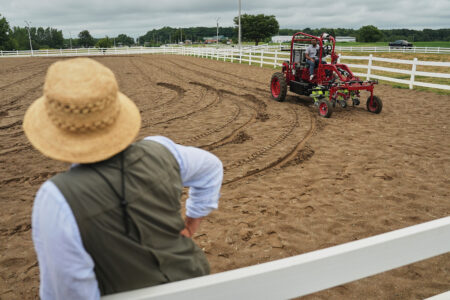
Will electric tractors gain traction?
Expedited Congressionally mandated disaster assistance for farmers announced
U.S. Secretary of Agriculture Brooke L. Rollins announced that agricultural producers who suffered eligible crop ...
SMSU Agronomy Field Day
The seventh annual SMSU Agronomy Field Day is scheduled for Friday, July 18, from 11 a.m.-1:30 p.m. at the SMSU ...
Farmers educate students on power of soybeans
The Yellow Medicine County Corn and Soybean Growers Board understands the vital role agriculture plays in rural ...
Strategic Farming: Let’s talk crops! webinar focused on corn insect pest challenges
On Feb. 26, Dr. Fei Yang, UMN Corn Extension entomologist, joined UMN Extension Crops Educator Dr. Anthony Hanson ...
USDA announces Aug. 14 application deadline for Emergency Relief Program Assistance for commodity and specialty crop producers
The U.S. Department of Agriculture (USDA) announced the deadline for commodity and specialty crop producers to ...